

Understanding Battery Thermal Management Systems (BTMS)

BTMS Product Series

In electrified platforms, thermal management has shifted from a supporting function to a core design challenge.

It’s no longer enough to simply keep a battery within a safe temperature range. Engineers are now working with higher energy densities, faster charging, emerging cell technology and more demanding duty cycles, all of which increase the thermal load placed on the system.

It could be an electric bus, a hydrogen fuel cell vehicle, or an electrified off-highway machine but the target is the same – maintain stable battery temperature. This is fundamental to performance, efficiency, and long-term reliability.

That’s where Battery Thermal Management Systems (BTMS) come in.

In this article, we’ll look at how a BTMS operates, and why it has become such a critical part of modern electrified powertrains.

Firstly, though, we need to understand what is a BTMS?

What is a Battery Thermal Management System (BTMS)?

A BTMS is designed to control the temperature of a battery pack, ensuring it operates within a defined and consistent range.

But in practice, it’s doing more than temperature control alone. 

It’s managing how heat is generated, distributed, and removed across the entire battery system. In real-world operation, temperature isn’t uniform. Different cells, different loads, and different conditions all create variation.

If that variation isn’t controlled, it leads to inefficiencies, uneven ageing, safety critical risks and reduced overall performance.

Batteries generate heat during both charge and discharge cycles. Without effective thermal control, this heat builds up, impacting efficiency and accelerating degradation over time. In more extreme scenarios, it can also introduce safety concerns.

A BTMS addresses this by actively regulating the system. It monitors thermal conditions and adjusts how heat is managed, using a combination of coolant flow, ambient air, and in many cases, refrigerant-based active cooling.

And importantly, it does this continuously. Not as a fixed system, but as one that responds in real time to changing conditions.

Now we know what it is and what it does, the next natural question is “how”?

How a BTMS Works

Although it can get complicated the deeper you dive into it, at its core, a BTMS transfers heat away from (or into) the battery module using a controlled thermal circuit.

Most commonly, this is done through a liquid cooling loop. The coolant, typically a water-glycol mixture, absorbs heat from the battery cells and carries it away from the pack.

From there, the system determines how that heat should be handled.

In favourable conditions, heat can be rejected directly to ambient air through an air-to-water radiator. This is the most energy-efficient mode of operation, as it avoids the need for additional power input. This mode is also known as passive cooling.

However, when ambient temperatures rise or thermal loads increase, this approach becomes less effective. The system then transitions to active cooling, using a refrigerant cycle to reduce coolant temperatures below ambient and maintain control.

Have you read our active vs passive cooling article? Make sure to sign up to our newsletter here so you never miss an entry

Why Battery Thermal Management Matters

Whilst we’ve briefly gone over this, it’s important to really understand the pros and cons of why battery thermal management matters. Battery performance is highly temperature dependent. Operate within the optimal range, and the system delivers safe and consistent performance, efficient energy usage, and long service life – move outside of that range, and the impact is immediate. High temperatures accelerate degradation and reduce efficiency whereas low temperatures limit power output and affect charging performance. 

But it’s not just about absolute temperature. Consistency across the pack is equally important.

If some cells run hotter than others, you introduce imbalance. Over time, that imbalance leads to uneven ageing, reducing the effectiveness of the entire battery system.

A well-designed BTMS helps to:

  • Maintain stable operating temperatures
  • Minimise temperature variation across the battery pack
  • Support efficient energy use under varying conditions
  • Extend overall battery lifespan
  • Manage safety risks, which rise sharply once cells move outside the optimal range, particularly under fast charging or fault conditions

As applications become more demanding, these factors are not only harder to manage, but more critical to get right. When addressed effectively, they can significantly reduce operating costs and downtime, providing greater stability in the most challenging environments where uptime and reliability are key to a successful deployment of battery systems and TCO (total cost of ownership) models are key to commercial success of projects.

Duty Cycle and Real-World Operation

Vehicles, machines and stationary power applications all operate across different duty cycles, environments, and usage patterns, each placing varying demands on the battery and its cooling system. From stop-start urban routes in cold climates to sustained high-load, high-ambient operation, these conditions directly influence how heat is generated, managed, and dissipated.

In urban applications, frequent stop-start operation creates fluctuating heat loads. This places greater reliance on active thermal control.

Ambient conditions add another layer. Systems must operate across a wide temperature range, from cold starts in extreme winter to high ambient conditions in summer.

Charging introduces further complexity. Rapid charging is getting more common as EV applications grow putting more pressure on charging infrastructure and grid power. Rapid charging will generally generate higher levels of heat in a short time, often requiring more aggressive active cooling strategies than during standard discharge operation. Or a software defined BTMS strategy to pre-condition batteries to a lower pack temperature before deployment of rapid charging.

These factors influence how a BTMS is designed.

In many cases, the most effective systems combine both, adapting to the conditions rather than relying on a single approach.

BTMS in Practice: Hydrogen Bus Application

The role of a BTMS becomes even more critical in real-world applications such as hydrogen fuel cell electric buses. Working with PAK-PCE Polski Autobus Wodorowy on its NesoBus platform, Grayson delivered a compact, roof-mounted system designed to operate within a high-voltage architecture while meeting strict packaging constraints.The challenge was to maintain stable battery temperatures across stop-start urban duty cycles, varying climates, and interaction with the fuel cell system.

To address this, a fully integrated BTMS was deployed, combining active cooling, passive cooling, and heating within a single unit, enabling consistent performance in both high and low ambient conditions.Now in production, with more than 100 vehicles deployed, the system continues to maintain stable battery temperatures in real-world operation. This has supported reliable performance, improved efficiency, and long-term battery durability, demonstrating how an effective BTMS can enable the transition from prototype to scalable, production-ready platforms.

Packaging and Vehicle Integration Constraints

Beyond performance, integration plays a major role in system design - and the challenges here vary significantly depending on the application. In passenger and transit vehicles, the BTMS is often roof-mounted, sharing limited space with HVAC units and energy storage components. In off-highway machines - think excavators, mining trucks, or agricultural equipment - the constraints are different but no less demanding.

Available space is often irregular, environments are far harsher, and the system needs to withstand vibration, dust, and extreme operating temperatures that you simply don't encounter on a bus route.

Stationary power applications bring their own set of considerations. While there's generally more flexibility in physical layout, thermal systems still need to be designed around the specific enclosure, ambient conditions, and duty cycle of the installation - whether that's a grid-scale battery storage unit or a backup power system in a remote location.

Across all these applications, weight distribution and centre of gravity remain important factors where relevant, and there's always a need to balance thermal capability with the physical realities of the installation.

This is where compact, integrated designs earn their place. By combining multiple functions into a single system and optimising component layout, it becomes possible to reduce complexity and make more efficient use of whatever space is available - whether that's a rooftop, an engine bay, or an equipment enclosure.

Compact, Integrated BTMS Design in Practice

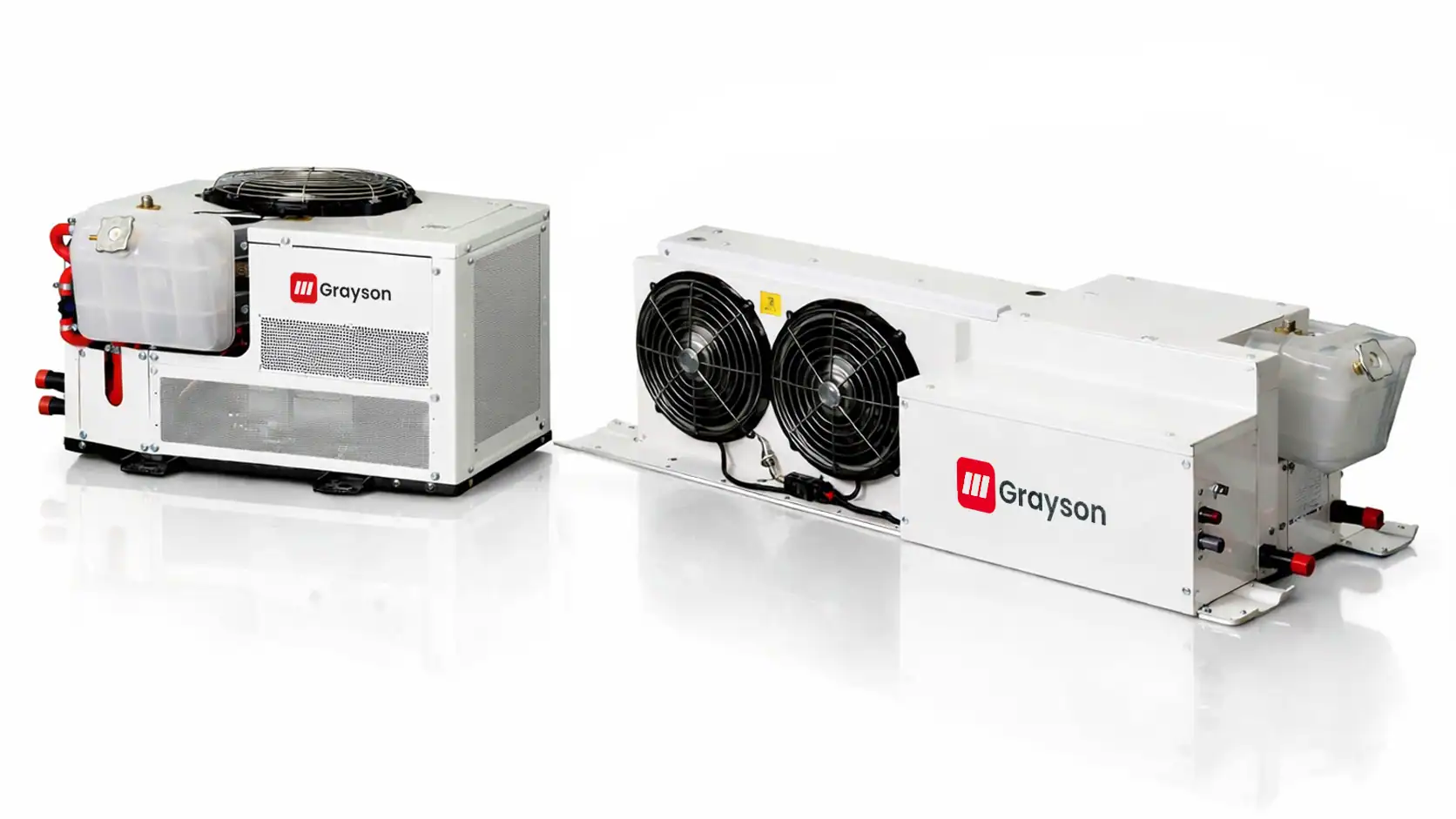
Grayson's BTMS M1 has been designed specifically to address these challenges. Developed for battery-electric and fuel-cell-electric vehicles, it combines liquid-cooled battery heating and cooling within a compact, self-contained package that can be mounted on the roof, chassis, or vehicle body – pre-charged with refrigerant gas for ease of installation / plug and play and aftersales benefits were service exchange is the most effective model for up-time.

Rather than relying on multiple separate components distributed throughout the application (vehicle, machine or static container) key elements including the water pump, header tank, fan, control module, and refrigerant circuit are integrated within a single unit. This reduces installation complexity, minimises pipework and wiring requirements, and simplifies vehicle integration.

The system continuously monitors battery coolant temperatures and automatically transitions between passive cooling, active cooling, and electrical heating as operating conditions change. This allows batteries to remain within their optimal temperature range during high ambient operation, rapid charging events, cold weather starts, and varying duty cycles. The compact design also supports applications where packaging constraints would otherwise limit thermal management options.

Despite its reduced footprint, the system delivers cooling capacities of up to 5.8kW and supports high-voltage architectures up to 900V DC, making it suitable for both current and next-generation electrified platforms. Importantly, integration is not only about physical packaging. Modern BTMS solutions must also integrate seamlessly with the wider electrical architecture. Using CAN J1939 communication and customer-specific control strategies, systems can be configured to operate alongside vehicle control systems, supporting real-time diagnostics, software updates, and optimised thermal performance throughout the vehicle lifecycle.

There is no one-size-fits-all approach to battery thermal management.

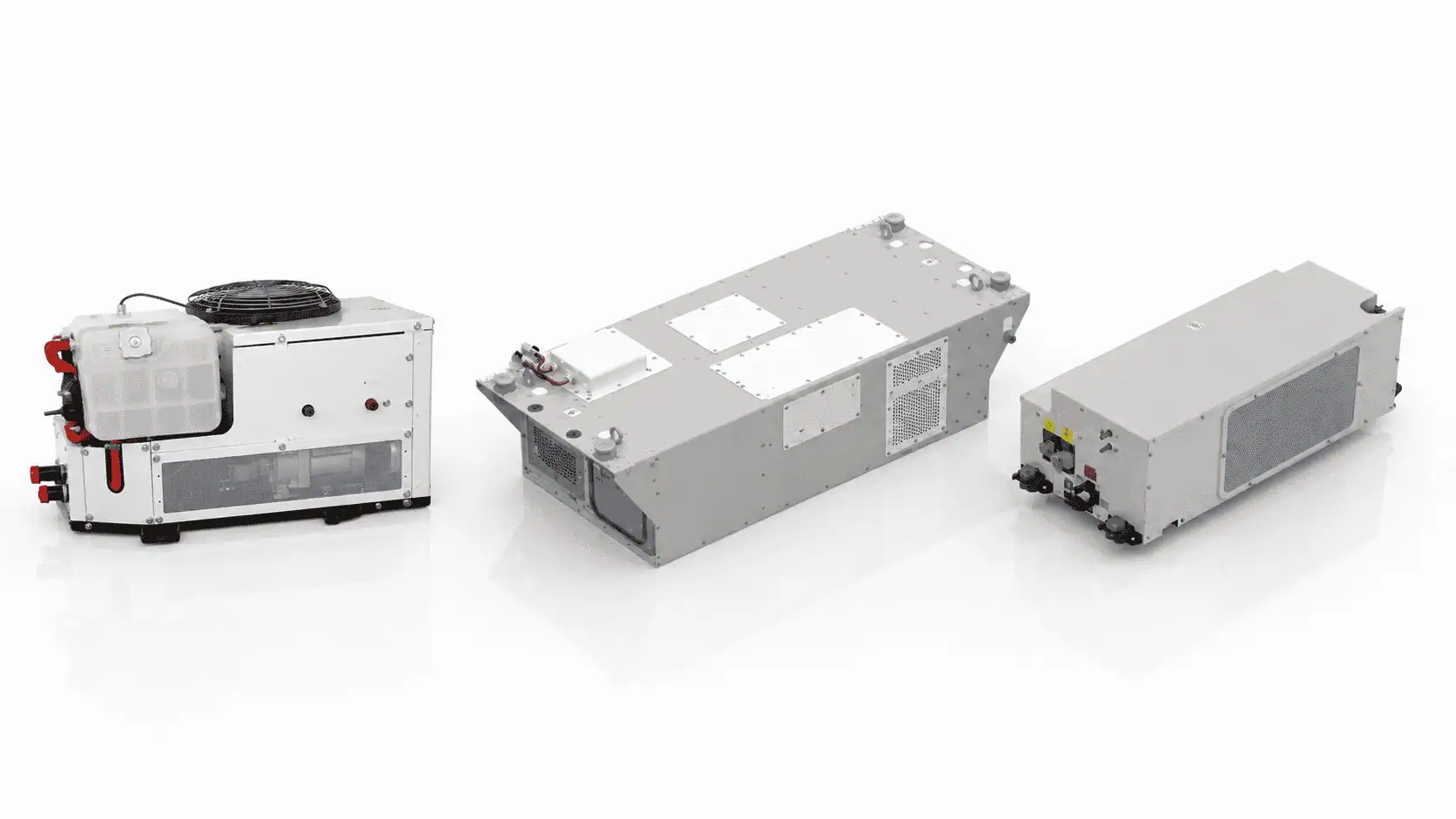
Different applications require different cooling capacities, packaging arrangements, compliance requirements, and control strategies. To meet these varying demands, BTMS solutions are typically developed around the needs of a specific application, whether that is a mobile vehicle platform, a rail system, or a stationary energy storage installation.

BTMS Product Solutions

M-Series

R-Series

The BTMS R-Series is designed specifically for rail, where reliability and compliance are critical. Engineered to meet rolling stock standards, it provides controlled battery heating and cooling throughout both operation and charging cycles. This level of thermal stability is particularly important in rail environments where systems are exposed to wide temperature variations and long service hours, helping to protect battery health, support safety requirements and ensure dependable performance across passenger, freight and tram networks.

BTMS R1

S-Series

The BTMS S-Series focuses on stationary power applications, including battery energy storage systems that operate under constant load. Designed for continuous-duty use, it delivers stable, liquid-cooled thermal management in a low-profile, AC-powered format. In real-world scenarios such as grid support or renewable energy storage, this consistency helps maintain charging efficiency and protects battery systems over time, even in demanding ambient conditions where temperature control is essential for long-term reliability.

BTMS-S1-Product-Page-Featured-Image-Size

A Critical System for Electrification

As electrified systems continue to evolve, the role of thermal management will only become more significant. A BTMS is not just protecting the battery. It is enabling consistent performance and helping systems operate reliably under increasingly demanding conditions. And as platforms become more complex, the way thermal systems are designed and integrated will continue to evolve alongside them.

In future Grayson Thermal Academy articles, we’ll explore how these systems connect with wider thermal architectures, including refrigerant strategies and system-level integration.