

Pressure, Flow Rate and Electric Water Pumps: What Really Matters in Modern Thermal Management Systems

If you’ve ever looked at an electric water pump datasheet and thought, “That flow rate looks plenty,” you’re not alone. Flow rate is usually the headline figure. It’s easy to compare, easy to specify, and easy to misunderstand.

In reality, flow rate only matters if the pump can deliver it at the pressure your system demands. And in modern electrified platforms – where coolant circuits are longer, tighter and far more complex – that distinction becomes critical.

Let’s unpack why pressure and flow are inseparable, how they behave in real systems, and what that means when selecting electric water pumps for BTMS, CTMS, coolers and HVAC applications.

Flow Rate Looks Simple - Until You Install the Pump

On paper, flow rate feels intuitive: more flow equals better cooling. But that assumption only holds in a frictionless world… and thermal systems are anything but frictionless.

Once a pump is installed into a real coolant loop, it immediately encounters resistance from:

  • Pipe length and diameter
  • Bends, fittings and manifolds
  • Heat exchangers and cold plates
  • Valves, filters and control hardware

Why More Flow Does Not Always Mean More Cooling

Increasing coolant flow in a thermal management system does not always result in improved cooling performance.

While higher flow can enhance heat transfer up to a point, every system has an optimum flow rate at which heat transfer efficiency is maximised. Beyond this point, additional flow can reduce thermal performance due to shorter fluid residence time, increased pump work, higher turbulence-induced inefficiencies, and diminished temperature differentials across the heat exchanger.

Therefore, effective thermal design requires identifying and operating at the optimum flow rate rather than assuming that more flow will automatically provide better cooling.

Each of these elements adds pressure loss. And as pressure loss increases, actual delivered flow drops. A pump rated for high free-flow output may perform very differently once installed into a dense, high-resistance system.

This is where pressure capability stops being an abstract spec and starts being the deciding factor.

Let’s look at what “pressure” really means in a thermal system, and why it’s often underestimated.

Pressure Is Simply the Cost of Moving Coolant

Pressure in a closed-loop thermal system isn’t about strength or force, it’s about what the pump must overcome to keep coolant moving.

Every restriction in the system creates a pressure drop. The pump’s job is to generate enough differential pressure to overcome the total system resistance and maintain the required flow.

As systems become more complex, pressure requirements rise quickly:

  • Smaller hose diameters increase velocity losses
  • Plate heat exchangers add sharp pressure drops
  • Parallel cooling circuits increase total resistance
  • Long routing distances compound friction losses


At some point, a pump reaches the limit of what it can deliver. Beyond that point, flow collapses, regardless of the pump’s nominal flow rating.

This is the reason why two pumps with identical “maximum flow” figures can behave completely differently once installed.

To fully appreciate this, we need to talk about operating points.

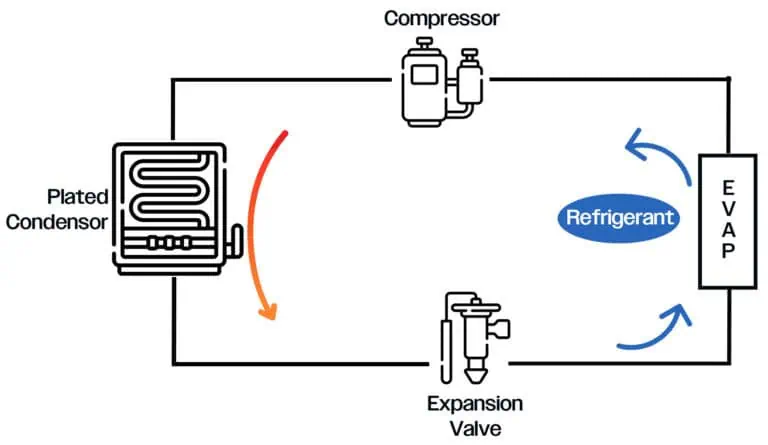
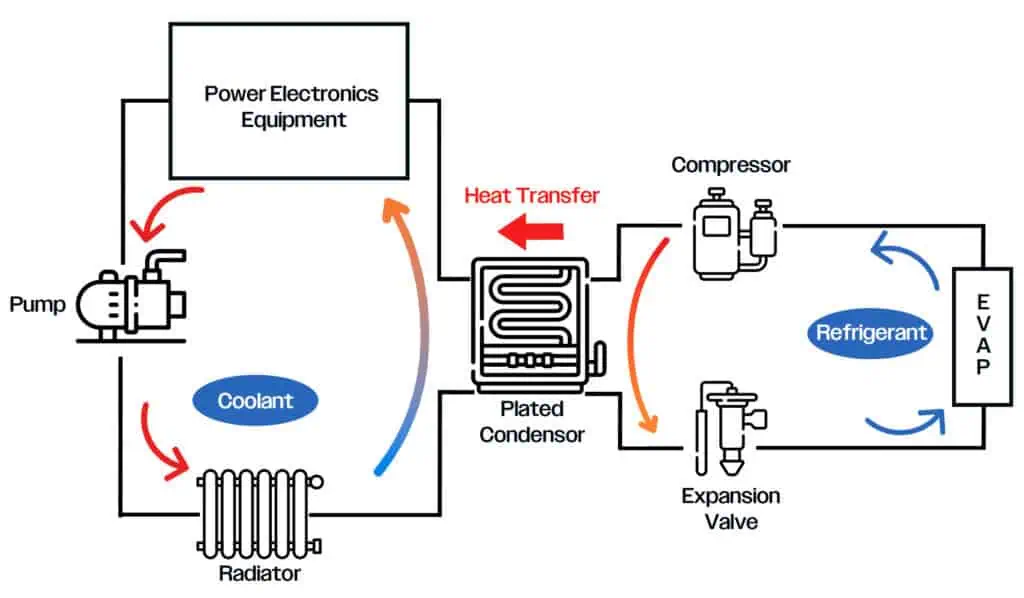
Indirect Condensing Cycle
Figure 1: Indirect condensing cycle with coolant flow

Interested in finding out more about direct vs indirect condensing ? Read our blog - you can learn more about the pressure and flow of a coolant in a system too! Have a look here.

The Operating Point: Where Pump and System Actually Meet

Every pump has a pressure–flow curve. Every thermal system has its own resistance curve. Where those two curves intersect is the operating point. And for those developing the thermal architecture of their vehicle, this is the only point that actually matters.

This operating point defines:

  • The real flow rate delivered
  • The pressure the pump must generate
  • The electrical power the pump consumes
  • The stability of the system over time


If the operating point falls outside the pump’s efficient region, problems start to appear:

  • Insufficient heat transfer
  • Excessive electrical load
  • Noise and cavitation risk
  • Reduced pump life


This is why Grayson approaches pump selection as a system exercise, not a component swap.

But what does this mean in real applications engineers work with every day?

The Operating Point: Where Pump and System Actually Meet

Let’s consider battery thermal management – a critical and unforgiving requirement of any electric vehicle. A typical liquid-cooled battery system includes:

  • Cold plates with narrow internal channels
  • Long coolant routing across the vehicle
  • Multiple connectors and distribution blocks

All of this adds up to high system resistance.

If pump pressure capability is underestimated:

  • Flow drops unevenly across battery modules
  • Localised hot spots appear
  • Cell ageing accelerates
  • Fast-charge performance is compromised


In BTMS applications, stable flow matters just as much as absolute flow. This is why pumps must be selected for pressure capability first and not just for the headline flow.

Now let’s scale that challenge up.

Integrated Systems Multiply the Challenge

When pumps move from standalone loops into integrated architectures, the challenge becomes more dynamic.

In increasingly complex multi-loop thermal management systems, electric water pumps may have to contend with:

  • Coolant being shared or exchanged between loops
  • Flow demand changing depending on operating mode
  • Heat rejection paths shifting dynamically


A pump that performs well at one operating point may struggle at another if pressure head is insufficient.

This is where pump technology and control philosophy must work together. At Grayson, our approach is to work closely with our OEM partners to:

  • Model multiple operating conditions
  • Select pumps that remain stable across the full pressure envelope
  • Use control strategies to maintain flow where it matters most


And it is always important to remember that electric water pumps don’t operate in isolation; they influence everything downstream.

Why Magnetic Drive Pumps Excel in High-Resistance Systems

Magnetic drive pumps bring a practical advantage that matters in modern thermal systems.

By eliminating mechanical seals, magnetic drive designs:

  • Reduce internal leakage paths
  • Tolerate higher operating pressures
  • Minimise wear under continuous duty
  • Improve long-term reliability

Grayson’s MD-Series magnetic drive pumps are designed specifically for applications where pressure stability is non-negotiable.

Combined with brushless DC motors and flexible control (standalone, PWM or CAN), these pumps maintain predictable performance even as system resistance changes. And it is that predictability that enables confident system-level design.

Flow Stability Drives Thermal Performance Everywhere

Once pressure–flow behaviour is understood, the next question engineers usually ask is: “So what actually happens if flow isn’t stable?” Well, the answer is simple: thermal performance becomes unpredictable.

Across almost every vehicle and power application, stable and reliable coolant flow is what allows heat exchangers, heaters and coolers to do their job consistently. When flow fluctuates, drops away under load, or varies across operating modes, component temperatures follow suit.

Let’s look at some of the systems on a heavy vehicle or machine where this matters most.

In a future Grayson Thermal Academy article, you’ll see how our CTMS RM-Series showcases pump capability and integration all working together to deliver predictable, efficient thermal performance in real-world applications. Sign up to our newsletter here to ensure you’re in the know.

Passively Cooled Systems: Engines, Motors, and Fuel Cells

Whether it’s a combustion engine, traction motor or hydrogen fuel cell stack, the underlying challenge is the same: large amounts of heat must be removed continuously to keep the system within safe operating limits.

Internal Combustion Engines

Traditionally, engine-driven mechanical pumps handled coolant circulation. However, electric water pumps are now increasingly used:

  • As auxiliary pumps in hybrid platforms
  • For thermal decoupling and faster warm-up
  • In stop-start and low-speed operating modes


In these cases, stable electric pump flow ensures:

  • Even temperature distribution across the engine block
  • Effective heat rejection through the radiator
  • Reduced risk of localised boiling or thermal stress


If flow drops under high load or low-speed operation, coolant velocity through the cooler decreases, reducing heat transfer efficiency and increasing the risk of overheating.

Traction Motors and Power Electronics

Electric motors and inverters generate intense, concentrated heat, often over relatively small surface areas.

Here, stable flow is critical because:

  • Heat exchangers and cold plates rely on consistent coolant velocity
  • Reduced flow lowers convective heat transfer coefficients
  • Temperature gradients can form rapidly


In high-resistance circuits, insufficient pump pressure can lead to uneven cooling, where some components are adequately cooled while others are not — a common cause of derating and long-term reliability issues.

Hydrogen Fuel Cells

Fuel cell systems are particularly sensitive to thermal imbalance.

They require:

  • Tight temperature control
  • Even heat removal across the stack
  • Stable operation across varying loads


Any fluctuation in coolant flow can affect reaction efficiency, durability and water management within the stack.

In fuel cell applications, pressure-capable, stable-flow electric pumps are essential, not optional.

Cooler-FC2-Product-Page-Featured-Image-Size.
FC2: Part of Grayson’s dedicated range of air-to-liquid coolers for hydrogen fuel cell applications

HVAC and Heating Circuits

In HVAC and heating systems, the impact of flow instability is felt immediately by drivers and passengers.

Heating Circuits

For liquid-based heaters (heat pumps, electric water heaters or engine-coolant heaters), stable flow ensures:

  • Predictable heat output
  • Fast warm-up times
  • Even heat distribution across heat exchangers


If flow drops, heater performance falls away rapidly, leading to:

  • Slow cabin warm-up
  • Inconsistent temperature control
  • Increased electrical or fuel demand as systems compensate
Grayson EW-series - 2 PTC Electric Water Heaters
EW series: Grayson’s range of electric water heaters designed to deliver rapid, reliable auxiliary heating
Cooling and Air Conditioning

On the cooling side, stable coolant flow supports:

  • Efficient chiller operation
  • Consistent evaporator performance
  • Smooth transitions between operating modes


In integrated HVAC or CTMS architectures, where coolant flow may be dynamically redirected, pressure-capable pumps ensure flow remains stable even as system demands change.

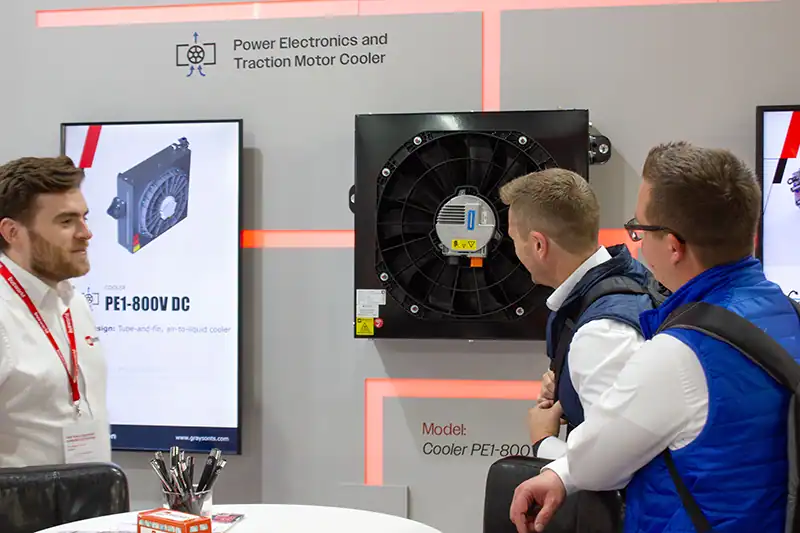
Cooler-PE1-Product-Page-Featured-Image-Size
PE1 Cooler: Part of Grayson’s range of air-to-liquid coolers for power electronics and traction motors

One Principle, Many Systems

What links all of these applications – powertrain cooling, BTMS, HVAC and CTMS – is a single principle: Heat transfer only works as well as the coolant flow supporting it.

Flow that looks sufficient on paper can quickly become inadequate once pressure losses, operating modes and real-world resistance are accounted for.

This is why pump selection cannot be isolated from system design.

Bringing It All Together: Why System-Level Thinking Always Wins

  1. Selecting an electric water pump is not about choosing the biggest number on a datasheet.

It’s about answering three practical questions:

  1. What flow does the system actually need?
  2. What pressure does the system impose at that flow?
  3. How does that operating point change over time?

And by answering those questions properly, engineers can confidently develop applications with stable systems that deliver predictable performance and avoid late-stage compromises, erratic performance and unforeseen derating issues.

This is why Grayson never considers electric water pumps in isolation when working with OEMs. Instead, we take a system-level approach to pump selection, working with you to:

  • Understand full system resistance and operating modes
  • Select or configure pumps based on real pressure–flow requirements
  • Integrate pumps into complete thermal management systems
  • Validate performance through testing and real-world application experience

Whether you’re selecting a single electric water pump or developing a fully integrated BTMS or CTMS architecture, our team is happy to share insight, data and practical guidance.

Understanding pressure-flow behaviour is only the first step. Applying it correctly within a real vehicle or machine architecture is where performance is won or lost.

If you want to explore how pump selection, control strategy and system layout interact in your application, our engineering team are happy to help. A short conversation early on can prevent compromises later in development – contact us to find out more.

Related Articles

Operating bus and coach fleets is a complex task. You need to be able to balance reliability, comfort, and safety for passengers in all conditions. Maintenance sits at the heart of this, helping to ensure vehicles and their HVAC systems operate efficiently throughout the year.

During the winter months, this becomes even more critical. Falling temperatures place additional strain on thermal systems and key components, particularly within electric and hybrid vehicles that rely on reversible Heat Pump Systems to deliver both heating and cooling.

Proactive preparation is essential. Without it, operators risk increased downtime, reduced passenger comfort, and long-term component wear. To help you get ready for the colder season, we’ve outlined five essential maintenance tips to keep your electric bus and coach fleets performing optimally – even when the temperatures drop.

1. Maintain HVAC Systems Before The Cold Weather Sets In

As winter approaches, a thorough pre-season HVAC inspection should be your first step. Check that refrigerant levels are within the correct range and that compressors are operating efficiently. Heat pumps used in Grayson systems – such as the Driver Cabin Heat Pump – operate in reversible cycles, switching from cooling to heating as seasons change. Ensuring these are serviced ahead of winter helps maintain reliability and energy efficiency once temperatures fall.

A system operating at its design performance not only improves passenger comfort but also reduces electrical load, extending vehicle range and supporting fleet uptime during demanding winter schedules.

2. Clean/Replace Filters Regularly

Filters are vital for both system performance and passenger comfort, ensuring clean airflow and protecting internal components from dust and debris. However, during colder months, when heating is in higher demand and airflow is more restricted, blocked filters can severely impact efficiency.

As stated by our service guidance, air filters should be serviced at least every six months, or more frequently for high-utilisation fleets.

Blocked filters can mean:

  • Lack of air circulating effectively, forcing HVAC systems to work harder and draw more power to maintain temperature.
  • In severe cases, restricted airflow causing compressor cycling, component strain, and a reduction in vehicle range.
  • Once partially blocked, components degrade quickly as the same mass airflow is forced through a smaller area, accelerating system wear.


Our filter servicing video below demonstrates best practices for replacing filters on buses – typically every six months – and these same principles can be applied to almost all bus models.

Please refer to your specific manufacturer’s guidance on system components to ensure safe and correct protocols are adhered to. 

If you’re unsure about filter specifications or intervals for your vehicles, Grayson can provide a tailored maintenance plan including recommended products, part numbers, and service intervals specific to your fleet. Read here to learn more. 

3. Keep Windows Mist-Free and Visibility Clear

Condensation and fogging are common during winter, but effective HVAC operation can prevent these issues. Ensure systems are fully functional in demist mode, and that sensors, airflow paths, and heating elements are unobstructed. Please check your driver panel manual or driver card for your vehicle specification to ensure that systems are being utilised correctly.

Grayson’s HVAC systems and Demisters are designed for all-season performance, with rapid demisting functionality to maintain visibility in even the harshest winter climates. This not only protects passenger safety but also prevents moisture accumulation that can lead to longer-term corrosion or damage.

We’ll be exploring these next-generation natural refrigerants in more detail in upcoming Grayson Thermal Academy deep-dives. Click here to subscribe to the Thermal Exchange so you don’t miss it.

4. Maintain Battery Thermal Performance in Cold Climates

Battery health directly impacts vehicle reliability and range. During cold conditions, maintaining an optimal battery temperature is essential to ensure consistent power delivery and efficiency.

Grayson’s Vehicle BTMS uses advanced reversible heat pump technology and optional electric heating to provide precise thermal control. Managed through the GTS Controller, the system actively heats or cools liquid-cooled batteries to maintain ideal temperature ranges, even in freezing conditions.

We’ve also developed an all-in-one solution in our CTMS (Complete Thermal Management System) RM-Series – providing everything necessary for your vehicle’s thermal management (a reversible heat pump providing battery, HVAC, and powertrain cooling and heating). This system also has a Pre-conditioning mode, which heats your vehicle for maximum efficiency before setting off.

The result: predictable performance, extended battery life, and reduced downtime – all critical for operators aiming to meet service schedules through winter.

5. Run a Complete Thermal Management Health Check

Beyond visual inspections, running diagnostic checks across your vehicle’s thermal management system can help identify potential performance issues before they lead to failures.

Our service engineers recommend conducting a full system diagnostic ahead of winter, covering coolant flow, valve actuation, electrical systems, and software updates. Should any technical support be needed following these checks, our dedicated technical support team is available to assist. Our systems like the CTMS and BTMS, offer CAN communication to ensure you’re never left in the dark during the winter months when you need to see where your vehicle may be falling behind.

The Importance of Proactive Maintenance

Proactive maintenance doesn’t end with scheduled servicing – it also means preparing for unexpected challenges. Stocking key replacement components, such as filters, coolant, and pumps, ensures your vehicles can be maintained efficiently during periods of high demand or adverse weather.

All systems within a vehicle thermal management setup use the same core components year-round – operating in reverse to provide heating in winter and cooling in summer. This means maintenance tasks such as filter servicing, refrigerant checks, and coolant top-ups are equally relevant across both seasons.

To help operators manage this more effectively, Grayson’s Aftermarket and Servicing offer tailored maintenance support packages designed to reduce the pressure on service teams and keep fleets running smoothly all year. These plans include pre-season servicing, diagnostic testing, and a ready next-day supply of high-quality recommended parts.

Grayson - Your Winter Maintenance Partner

For over 40 years, Grayson has supported fleet operators around the world with advanced thermal management technologies that deliver reliability and comfort in all conditions.

From our HVAC, Battery Thermal Management Systems (BTMS) and Complete Thermal Management System (CTMS) – DB-Series, to our dedicated Service Division – staffed by more than 30 experienced engineers across the UK – we’re here to keep your fleet running efficiently, whatever the weather.

To help operators manage this more effectively, Grayson’s Aftermarket and Servicing offer tailored maintenance support packages designed to reduce the pressure on service teams and keep fleets running smoothly all year. These plans include pre-season servicing, diagnostic testing, and a ready next-day supply of high-quality recommended parts. With us, operators can be confident that their vehicles will continue to perform – even on the coldest winter mornings.

Contact us today to discuss a maintenance plan for your fleet or explore our Servicing and Maintenance and Technical Support solutions.

Related Articles

Staying Compliant: How OEMs and Operators Can Meet F-Gas Regulations with Confidence

In our previous thermal academy blog, we did a deep dive into F-gas regulations, exploring how the latest F-gas legislation is reshaping refrigerant choices and thermal system design across bus and coach, off-highway, rail, special vehicle, and stationary power sectors.

This follow-up focuses on what OEM engineers can do to stay ahead with five best practices that support compliance today while helping you prepare for the next generation of refrigerants, standards, and system architectures.

1. Stay Current with Regulations and Standards

Regulations around refrigerants are evolving rapidly, and not just in the EU and UK, but globally. Staying compliant means keeping pace with updates to F-Gas regulations, Euro emissions standards, and environmental safety directives.

This includes monitoring:

  • Changes to Global Warming Potential (GWP) limits for refrigerants
  • Certification requirements for handling new gases
  • Sector-specific rules across public transport, off-highway, rail and stationary power applications


For OEMs, these aren’t one-time updates, but rather they directly influence refrigerant selection, testing protocols, and long-term platform planning.

At Grayson, our team of F-Gas specialists continually track regulatory changes and emerging refrigerant technologies, ensuring the systems we design for our customers are compliant today and future-proofed for tomorrow.

2. Choose Low-GWP and Natural Refrigerants with a Long-Term Strategy

Where possible, adopting low-GWP or natural refrigerants is one of the most effective ways to maintain compliance and reduce environmental impact. Options such as R-454C, R-1234yf, R-290 (Propane), and R-744 (CO₂) offer lower GWP values, however, each brings trade-offs in efficiency, compatibility, and safety that engineers must carefully assess.

We’ll be exploring these next-generation natural refrigerants in more detail in upcoming Grayson Thermal Academy deep-dives. Click here to subscribe to the Thermal Exchange so you don’t miss it.

It can be tempting to look for a direct drop-in refrigerant replacement. But long-term compliance and performance require a strategic refrigerant plan, not just a short-term fix.

This is why refrigerant strategy should be treated as a core engineering decision, not just a substitution exercise. Our engineers work directly with OEM design teams to evaluate model performance and safety under real-world duty cycles, helping identify the right balance of efficiency, serviceability, and compliance longevity.

3. Design Future-Ready Thermal Management Systems

The most effective route to long-term compliance is future-proof design. That means developing systems that can transition to next-generation refrigerants without major hardware redesigns.

Working with thermal management companies that understand the value of future-proof design is key. For example, at Grayson, we engineer our BTMS and CTMS product ranges for flexibility and refrigerant adaptability, enabling OEMs to move from refrigerants such as R407C to R454C with minimal requalification effort.

Our approach combines modular component design for easier refrigerant transitions, integrated architectures to reduce charge and potential leak points, and built-in diagnostics and CAN-based monitoring for ongoing compliance verification.

Grayson CTMS RM2-800V DC
CTMS RM-Series – RM2-800V DC

Also, designing for lower charge and reduced leak potential can offer reduce total cost of ownership and improve serviceability for operators. Under both EU and UK regulations, the CO₂-equivalent charge of a system determines its leak-checking frequency and reporting obligations – see figure 1. Lower charge systems not only simplify compliance but also improve reliability and environmental performance.

Techniques such as indirect condensing, compact heat exchangers, and integrated system layouts can significantly reduce the overall refrigerant volume required.

Leakage Detection Periodically Check
System WITHOUT Leakage Detection
No Check
Every 12 months
Every 6 months
Not Allowed
System WITH Leakage Detection
No Check
Every 24 months
Every 12 months
Every 6 months
Refrigerant Charge per Circuit (CO2 equivalent)
< 5 ton
5 ≤ Charge < 50 ton
50 ≤ Charge < 500 ton
Charge > 500 ton
Refrigerant Charge per Circuit (kg)
R134a (GWP 1430)
Charge < 3.5 kg
3.5 ≤ Charge < 34.9 kg
34.9 ≤ Charge < 349.7 kg
Charge > 349.7 kg
R407c (GWP 1774)
Charge < 2.8 kg
2.8 ≤ Charge < 28.2 kg
28.2 ≤ Charge < 281.9 kg
Charge > 281.9 kg
R410A (GWP 2088)
Charge < 2.4 kg
2.4 ≤ Charge < 23.9 kg
23.9 ≤ Charge < 239.5 kg
Charge > 239.5 kg
R32 (GWP 675)
Charge < 7.4 kg
7.4 ≤ Charge < 74.1 kg
74.1 ≤ Charge < 740.7 kg
Charge >740.7 kg
HFO R1234ze
Charge < 2.0 kg
2.0 ≤ Charge < 10.0 kg
10.0 ≤ Charge < 100.0 kg
Charge > 100.0 kg

Figure 2: EU 517 / 2014 amendment 2022 F-gas Regulation – Leak Checks (“ton” means tonnes of CO₂ equivalent (t CO₂-eq), not metric tons of refrigerant)

For full details on regulations and laws in the UK, refer to the official GOV.UK guidance on F-gases and HCFCs.

A good example is our CTMS CM-series, which integrates multiple thermal loops within a single, sealed refrigerant circuit, reducing potential leak points and total charge while maintaining efficient temperature control across battery, power electronics, and cabin thermal loads.

CM1-800V DC
CTMS CM Series - CM1-800V DC

4. Invest in Training, Certification, and Continuous Improvement

Even the best system designs rely on people who can maintain them safely. Ensuring that engineers and technicians are trained and certified to handle evolving refrigerants is vital for sustaining compliance and protecting operational integrity.

Training supports:

  • Safe refrigerant handling and leak detection
  • Proper system servicing and recovery practices
  • Consistent adherence to F-Gas reporting obligations


With over F-Gas and high-voltage certified engineers, Grayson invests heavily in internal training to ensure our teams are knowledgeable in the latest F-gas requirements. We support OEMs by sharing best practices, knowledge, and maintenance insights, and operators with expert aftermarket servicing support.

When your teams and service partners are confident in managing refrigerant systems, compliance becomes second nature, rather than a hurdle to be overcome.

Switching to alternative refrigerants is not just a case of swapping one gas for another. Engineers must reassess system design, components and controls under new operating conditions – while keeping an eye on cost, logistics and long-term serviceability.

5. Consider Total Lifecycle Performance and Serviceability

F-Gas compliance isn’t just about meeting current standards: it’s about sustaining efficiency and reliability over a product’s lifetime. OEMs should evaluate total cost of ownership (TCO), including:

  • Refrigerant availability and cost trends
  • Maintenance intervals and serviceability
  • Technician training needs and tooling requirements


Systems designed for reliability, efficient maintenance, and long service life help reduce downtime and lifecycle costs, while keeping emissions low and compliance intact.

Grayson’s Aftermarket and Servicing Division provides end-to-end support to ensure long-term performance:

  • A dedicated 24,000 sq. ft. Aftermarket facility
  • Extensive parts inventory for next-day delivery
  • Over 30 mobile service engineers with HVAC expertise
  • 180 kW, 3-position charging facilities for PSV and commercial vehicles


And, importantly, we use this in-field aftermarket knowledge to help inform our thermal system designs choices for future platforms. Working with us means having a partner who can support compliance not just in design, but through service and lifetime operation.

Compliance Today, Confidence Tomorrow

Staying compliant with F-Gas regulations is about more than meeting minimum standards – it’s about building systems that are ready for the future of electrified, efficient, low-emission heavy vehicles and power systems.

We bring together F-Gas expertise, engineering capability, and lifecycle support to help OEMs navigate this complexity with confidence. Whether you’re specifying refrigerants, developing next-generation platforms, or planning long-term servicing strategies, our specialists are here to help.

Get in touch with our engineering team to see how we can support your next project, and sign up to our newsletter to stay updated as we dive deeper into natural refrigerants in the next articles of this series.

Related Articles

Regardless whether you’re cooling batteries on an electric bus, managing HVAC in a mining truck, or controlling temperatures in a battery energy storage system, refrigerants and F-gases sit at the heart of every modern thermal management system.

For engineers working in bus and coach, off-highway, special vehicle and stationary power applications, the latest F-gas regulations are changing how systems are specified, designed, tested and maintained. The rules don’t just affect which refrigerant you select; they also have implications for component choice, system architecture, total charge, service strategies and long-term platform roadmaps.

In this thermal academy article, we’ll look at:

1. What Are F-gases and Why Do They Matter for Thermal Management

If you’re reading this, you may already know the significance of a fluorinated gas (F-gas), but in case you don’t, here’s a quick refresher.

F-gases are a group of man-made greenhouse gases widely used in refrigeration, air conditioning, heat pumps, and thermal management systems. They are effective refrigerants because of their stability and thermodynamic properties, but they also have a high Global Warming Potential (GWP) – sometimes referred to in the context of Total Equivalent Warming Impact (TEWI).

In practical terms, many F-gases have a significantly higher GWP than carbon dioxide (Figure 1 demonstrates the GWP of main refrigerants), meaning that even small amounts leaking from a system can have a major environmental impact.

Refrigerant GWP Category
HFC-R404A
3922
Very high > 2500
HFC-R410A
2088
High-700-2500
HFC-R407C
1774
High – 700-2500
HFC-R134a
1430
High 700-2500
HFC-R32
675
Medium 150-700
HFC/HFO-R513A
631
Medium 150-700
HFC-R454C (3)
148
Low < 150
HFO-R1234ze
7(1), 1(2)
Low < 150
HFO-R1234yf
4(1), 0(2)
Low < 150
R290 (Propane)
3
Low < 150
R744 (CO2)
1
Low < 150
R717 (NH3)
0 .
Low < 150

Because of their impact, F-gases have become a major focus in climate legislation in the EU, USA and UK. F-gas regulations are designed to phase down their use, reduce leakage and accelerate the adoption of lower-GWP alternatives, helping to support net-zero targets.

For engineers and OEMs, this makes refrigerant selection, system design and long-term compliance critical considerations in both new and retrofit thermal management projects across vehicles and stationary power systems.

Figure 1: GWP of main refrigerants (4th IPCC report)

(1)    2010 SAP report (Scientific Assessment Panel),

(2)    5th IPCC report (Intergovernmental Panel on Climate Change)

(3)   Has been added into the table, not part of IPCC report. From https://nationalref.com/products/r454c/.

We’ll now explore what the latest regulations actually say – and what that means in practice.

Understanding Regulations and Standards in the Industry

Where F-Gases are concerned, the transport, industrial machinery and stationary power industries must adhere to strict regulations intended to reduce overall emissions. To comply with these required standards, both manufacturers and operators must adopt appropriate cooling architectures, use specific refrigerants and follow defined procedures for handling, leak checking and service.

EU Regulations and Laws

In alignment with the European Climate Law, the European Commission proposed a new F-gas Regulation, leading to the adoption of Regulation (EU) 2024/573 on 7 February 2024, which became effective on 11 March 2024.

This updated regulation:

  • Introduces stricter measures to reduce hydrofluorocarbons (HFCs)
  • Aims for a complete phase-out of HFCs in the EU by 2050
  • Extends coverage to more equipment and gases
  • Enforces measures to prevent leakage during transportation, installation, servicing and disposal


From 2025, EU production of HFCs will be capped, with producers receiving rights equivalent to 60% of their average annual production from 2011 to 2013, reducing to 15% by 2036. This effectively tightens supply and pushes the market toward low-GWP and natural refrigerants.

Another important piece of legislation is the EU 517 / 2014 regulation, as amended in 2022, which was established to check for leaks. Under Article 4.4, operators are obligated to repair leakage without undue delay, and the frequency of leak checks is based on the refrigerant charge in tonnes of CO₂ equivalent per circuit.

When a leakage detection system is installed:

  • The required inspection frequency is halved
  • The system must alert the operator and itself be checked at least once a year
Leakage Detection Periodically Check
System WITHOUT Leakage Detection
No Check
Every 12 months
Every 6 months
Not Allowed
System WITH Leakage Detection
No Check
Every 24 months
Every 12 months
Every 6 months
Refrigerant Charge per Circuit (CO2 equivalent)
< 5 ton
5 ≤ Charge < 50 ton
50 ≤ Charge < 500 ton
Charge > 500 ton
Refrigerant Charge per Circuit (kg)
R134a (GWP 1430)
Charge < 3.5 kg
3.5 ≤ Charge < 34.9 kg
34.9 ≤ Charge < 349.7 kg
Charge > 349.7 kg
R407c (GWP 1774)
Charge < 2.8 kg
2.8 ≤ Charge < 28.2 kg
28.2 ≤ Charge < 281.9 kg
Charge > 281.9 kg
R410A (GWP 2088)
Charge < 2.4 kg
2.4 ≤ Charge < 23.9 kg
23.9 ≤ Charge < 239.5 kg
Charge > 239.5 kg
R32 (GWP 675)
Charge < 7.4 kg
7.4 ≤ Charge < 74.1 kg
74.1 ≤ Charge < 740.7 kg
Charge >740.7 kg
HFO R1234ze
Charge < 2.0 kg
2.0 ≤ Charge < 10.0 kg
10.0 ≤ Charge < 100.0 kg
Charge > 100.0 kg

Figure 2: EU 517 / 2014 amendment 2022 F-gas Regulation – Leak Checks (“ton” means tonnes of CO₂ equivalent (t CO₂-eq), not metric tons of refrigerant)

For full details on regulations and laws in the UK, refer to the official GOV.UK guidance on F-gases and HCFCs.

Euro VI and how it connects to F-gas legislation

Euro VI is a strict EU regulation aimed at reducing harmful emissions from heavy-duty vehicles like trucks and buses. It focuses on exhaust emissions – NOₓ, CO, hydrocarbons and particulate matter – rather than refrigerants themselves.

However, Euro VI sits alongside F-gas legislation as part of a broader environmental push. The drive to lower overall emissions and improve vehicle efficiency under Euro VI has encouraged OEMs and suppliers to scrutinise every source of greenhouse gas emissions, including those from thermal management systems.

Although Euro VI doesn’t set specific limits for refrigerant emissions, it works in combination with F-gas rules to encourage:

  • Lower-GWP refrigerant selection
  • Improved system efficiency
  • Reduced leakage and better maintenance practices.  

In a future Grayson Thermal Academy article, we’ll explore the upcoming Euro 7 emissions standards, the changes they bring and what they mean for thermal system design. You can sign up to The Thermal Exchange newsletter to be notified when it’s published. Sign up to our newsletter here to ensure you’re in the know.

The Combined Impact on Thermal Management:

As emissions limits become tighter, attention increasingly turns to auxiliary systems such as:


In electric and hybrid vehicles especially, thermal management affects both range and performance. Moving away from high-GWP refrigerants and into better-optimised systems is now part of the broader emissions-reduction strategy.  

Designing F-Gas Compliant Thermal Management Systems

Switching to alternative refrigerants is not just a case of swapping one gas for another. Engineers must reassess system design, components and controls under new operating conditions – while keeping an eye on cost, logistics and long-term serviceability.

System Efficiency and Component Compatibility

Refrigerants like R1234yf require carefully managed operating pressures and temperatures to maintain efficiency and avoid unnecessary system strain. Refrigerant-specific heat exchangers and system architectures are vital to maximise heat transfer without compromising safety or durability.

For example, Grayson’s CM-series CTMS has been developed to offer optimised performance compatible with next-generation refrigerants, supporting stable thermal control for high-voltage applications of up to 850 V. Our CTMS range can be configured for both vehicle and stationary power applications, providing centralised management of multiple thermal loops.

Complete Thermal Management System CTMS CM-series
CTMS CM-Series

Future-proofing designs with flexible refrigerant options

Grayson’s product portfolio is engineered with future refrigerant transitions in mind. Products such as:


are designed so that they can be adapted for different refrigerants and thermal duties, whether managing battery packs, power electronics or passenger cabins.

By integrating these systems, OEMs can meet evolving regulatory requirements, retain flexibility for future refrigerant changes or upgrades, and reduce the risk of costly redesigns later in the platform lifecycle.

This future-ready approach helps de-risk system development and prolongs the operational relevance of OEM platforms.

Grayson CTMS RM-Series

Engineering Considerations for Switching to Alternative Refrigerants

Transitioning to new refrigerants demands a system-wide engineering review. Aspects for engineers to evaluate include:

  • Material compatibility
  • Seal integrity
  • Lubricant selection
  • Pressure rating
  • Thermodynamic properties


Approaches to lower system refrigerant requirements, such as heat exchangers and secondary coolant loops (indirect condensing), are increasingly used to minimise environmental risk and improve serviceability.

If you’d like a refresher on this topic, we cover the differences and use cases of direct and indirect condensing in a separate Grayson Thermal Academy blog.

Additionally, incorporating smart control strategies for refrigerant management, temperature balancing, and fault detection enhances system reliability. Grayson’s expertise in integrated thermal systems, combined with the capability to adapt to future regulations and industry standards, enables OEMs to navigate these transitions efficiently while delivering high-performance, compliant systems.

Adopting Proactive Measures to Anticipate Regulatory Changes

Responding to regulations only when they come into force can leave engineering programmes scrambling. A more effective approach is to monitor regulatory trends and technology developments proactively.

This often includes:

  • Investing in R&D to validate new refrigerants and system architectures ahead of time
  • Assessing how proposed changes may impact current and future platforms
  • Building flexibility into system designs so you can pivot without major rework


By taking this proactive approach, OEMs can implement design changes before new emissions or F-gas requirements are mandatory, allocate resources more effectively and avoid last-minute redesigns. In addition, companies reduce the risk of programme delays, rushed engineering changes and unexpected field issues.

In short, a proactive stance can turn compliance from a constraint into a competitive advantage for forward-thinking OEMs.

The Role of Data in Enhancing Compliance and Operational Efficiency

Telematics systems and data analytics also play an important role in monitoring compliance in real time, as well as allowing businesses to track operational efficiency and ensure adherence to safety protocols.

Armed with this data, companies can monitor parameters like vehicle emissions in real time, and use systems to obtain actionable insights which help to optimise their fuel usage, reduce overall costs and ensure vehicles are operating safely.

For fleets and stationary power operators, this means they can:

  • Monitor factors such as energy consumption, cooling performance and system alarms
  • Use the insights to optimise fuel or energy use, reduce costs and maintain uptime
  • Demonstrate compliance with internal and external standards


Grayson’s products, including the CM-series and RM-series CTMS ranges, use CAN communication to share detailed system information with vehicle and fleet systems. As data becomes increasingly integral to vehicle and stationary power operations, leveraging these insights will be key to improving both compliance and operational effectiveness.

Common Alternative Refrigerants and Next-Generation Solutions

As the industry phases down high-GWP F-gases, alternative refrigerants are becoming increasingly central to new system designs.

Low-GWP and Natural Refrigerant Options

Options such as R-454C are gaining traction because they offer significantly lower GWP (R454C has a GWP of 148), while still delivering good performance. However, each alternative comes with its own handling, design and safety requirements that must be considered when specifying components and system layouts.

The table below shows what we are replacing current refrigerants (R134a and R407C) with and provides a comparison table of the characteristics when we want to achieve 10kW cooling capacity at 50°C ambient:

Current Next Generation

Unit

R134a

R513A

R1234yf

R407C

R454C

R290

CO2

Condensing Temperature
50
50
50
50
50
50
30
Condensing Pressure
bar
13.18
13.77
13.02
19.88
18.7
17.13
71.2
Power Input
kW
2.73
2.37
2.22
2.86
2.6
2.71
6.21
COP
5.22
5.15
-0.64
5.17
4.98
6.77
16.7
Requested Cooling Capacity
kW
10
10
10
10
10
10
10
Mass flow
kg/h
342
342
342
342
342
342
342
GWP
1430
573
< 1
1774
150
3
1
Safety Group
A1
A1
A2L
A1
A2L
A3
A1

Figure 3: Replacements of current refrigerants

Trade-Offs in Efficiency, Cost and Safety

While low-GWP refrigerants deliver environmental benefits, they can introduce new design trade offs:

  • Natural refrigerants like CO₂ require higher operating pressures, demanding more robust components and controls.
  • Hydrocarbons are efficient and cost-effective but introduce flammability risks, which means enhanced safety mechanisms and careful enclosure management.
  • Engineers must also account for characteristics like refrigerant glide. This is the temperature range over which a refrigerant blend evaporates or condenses at constant pressure. It occurs in zeotropic blends (like R-407C) because their components have different boiling points, causing phase change over a range of temperatures rather than at a single point (see figure 5).
  • Pure refrigerants and azeotropic blends have little or no glide (see figure 4). This affects heat exchanger design, system efficiency, and maintenance.
Figure 4: Single Component
Blend refrigerant
Figure 5: Blend

Other considerations must also be taken into account, like thermodynamic properties and compatibility with existing infrastructure, balancing upfront cost, operational safety and long-term system efficiency.

What’s Next for the Industry?

The future of refrigeration lies in systems designed around ultra-low-GWP refrigerants, intelligent controls, and modular thermal management.

As the electrification of vehicles and machinery accelerates, thermal systems will need to manage both refrigerant-based cooling and battery/electronics thermal loads in one integrated platform.

With this in mind, you should expect to see further development in:

  • Sealed system designs
  • New heat pump applications
  • Thermal loops optimised around specific refrigerants and use cases


OEMs that partner with experienced thermal management specialists will be better placed to adapt to these rapid changes, while still meeting performance, reliability and regulatory requirements.

What This Means for Your Next Thermal Management Project

F-gas regulations are reshaping the way thermal systems are specified and designed across bus and coach, off-highway, special vehicle, and stationary power applications. They touch everything from refrigerant selection to system architecture, testing, serviceability, and even the digital data that underpins compliance monitoring.

For OEMs and engineers, that means looking beyond immediate project needs and designing with the future in mind, from understanding how refrigerant GWP, charge limits and leak-checking requirements, to new phase-down schedules could affect your platforms over their lifetime.

For decades, our team of thermal management and F-gas specialists has worked directly with design, systems, and validation engineers to help navigate these complexities. We combine over forty years of experience in refrigerant-based cooling, battery and power electronics thermal control, and climate systems for heavy vehicles, with up-to-date understanding of the latest F-gas regulations, standards, and technologies.

Whether you’re developing a new platform or adapting existing systems for upcoming changes, we can help you:

  • Identify the most suitable refrigerants and architectures for your application
  • Balance performance, compliance, and serviceability
  • Integrate flexible, future-proof designs that keep pace with evolving legislation


Our team of thermal experts are here to make sure you stay compliant and stay ahead.

If you’re reviewing refrigerant options or planning your next generation of thermal systems, speak to our team today. We’ll help you turn regulatory challenges into smarter, more efficient, and future-ready designs.

Related Articles

Regardless whether you’re cooling batteries on an electric bus, managing HVAC in a mining truck, or controlling temperatures in a battery energy storage system, refrigerants and F-gases sit at the heart of every modern thermal management system.

For engineers working in bus and coach, off-highway, special vehicle and stationary power applications, the latest F-gas regulations are changing how systems are specified, designed, tested and maintained. The rules don’t just affect which refrigerant you select; they also have implications for component choice, system architecture, total charge, service strategies and long-term platform roadmaps.

In this thermal academy article, we’ll look at:

What F-gases are and why they have become a regulatory focus

The key EU and UK regulations that apply to heavy vehicles and stationary power

How these rules intersect with wider emissions legislation

What this means for refrigerant choice and thermal system design

How OEMs can build more future-ready, F-gas-compliant systems

1. What Are F-gases and Why Do They Matter for Thermal Management

If you’re reading this, you may already know the significance of a fluorinated gas (F-gas), but in case you don’t, here’s a quick refresher.

F-gases are a group of man-made greenhouse gases widely used in refrigeration, air conditioning, heat pumps, and thermal management systems. They are effective refrigerants because of their stability and thermodynamic properties, but they also have a high Global Warming Potential (GWP) – sometimes referred to in the context of Total Equivalent Warming Impact (TEWI).

In practical terms, many F-gases have a significantly higher GWP than carbon dioxide (Figure 1 demonstrates the GWP of main refrigerants), meaning that even small amounts leaking from a system can have a major environmental impact.

Refrigerant GWP Category
HFC-R404A
3922
Very high > 2500
HFC-R410A
2088
High-700-2500
HFC-R407C
1774
High – 700-2500
HFC-R134a
1430
High 700-2500
HFC-R32
675
Medium 150-700
HFC/HFO-R513A
631
Medium 150-700
HFC-R454C (3)
148
Low < 150
HFO-R1234ze
7(1), 1(2)
Low < 150
HFO-R1234yf
4(1), 0(2)
Low < 150
R290 (Propane)
3
Low < 150
R744 (CO2)
1
Low < 150
R717 (NH3)
0 .
Low < 150

Because of their impact, F-gases have become a major focus in climate legislation in the EU, USA and UK. F-gas regulations are designed to phase down their use, reduce leakage and accelerate the adoption of lower-GWP alternatives, helping to support net-zero targets.

For engineers and OEMs, this makes refrigerant selection, system design and long-term compliance critical considerations in both new and retrofit thermal management projects across vehicles and stationary power systems.

Figure 1: GWP of main refrigerants (4th IPCC report)

(1)    2010 SAP report (Scientific Assessment Panel),

(2)    5th IPCC report (Intergovernmental Panel on Climate Change)

(3)   Has been added into the table, not part of IPCC report. From https://nationalref.com/products/r454c/.

We’ll now explore what the latest regulations actually say – and what that means in practice.

Understanding Regulations and Standards in the Industry

Where F-Gases are concerned, the transport, industrial machinery and stationary power industries must adhere to strict regulations intended to reduce overall emissions. To comply with these required standards, both manufacturers and operators must adopt appropriate cooling architectures, use specific refrigerants and follow defined procedures for handling, leak checking and service.

EU Regulations and Laws

In alignment with the European Climate Law, the European Commission proposed a new F-gas Regulation, leading to the adoption of Regulation (EU) 2024/573 on 7 February 2024, which became effective on 11 March 2024.

This updated regulation:

• Introduces stricter measures to reduce hydrofluorocarbons (HFCs)

• Aims for a complete phase-out of HFCs in the EU by 2050

• Extends coverage to more equipment and gases

• Enforces measures to prevent leakage during transportation, installation, servicing and disposal

From 2025, EU production of HFCs will be capped, with producers receiving rights equivalent to 60% of their average annual production from 2011 to 2013, reducing to 15% by 2036. This effectively tightens supply and pushes the market toward low-GWP and natural refrigerants.

Another important piece of legislation is the EU 517 / 2014 regulation, as amended in 2022, which was established to check for leaks. Under Article 4.4, operators are obligated to repair leakage without undue delay, and the frequency of leak checks is based on the refrigerant charge in tonnes of CO₂ equivalent per circuit.

When a leakage detection system is installed:

• The required inspection frequency is halved, a

• The system must alert the operator and itself be checked at least once a year

Leakage Detection Periodically Check
System WITHOUT Leakage Detection
No Check
Every 12 months
Every 6 months
Not Allowed
System WITH Leakage Detection
No Check
Every 24 months
Every 12 months
Every 6 months
Refrigerant Charge per Circuit (CO2 equivalent)
< 5 ton
5 ≤ Charge < 50 ton
50 ≤ Charge < 500 ton
Charge > 500 ton
Refrigerant Charge per Circuit (kg)
R134a (GWP 1430)
Charge < 3.5 kg
3.5 ≤ Charge < 34.9 kg
34.9 ≤ Charge < 349.7 kg
Charge > 349.7 kg
R407c (GWP 1774)
Charge < 2.8 kg
2.8 ≤ Charge < 28.2 kg
28.2 ≤ Charge < 281.9 kg
Charge > 281.9 kg
R410A (GWP 2088)
Charge < 2.4 kg
2.4 ≤ Charge < 23.9 kg
23.9 ≤ Charge < 239.5 kg
Charge > 239.5 kg
R32 (GWP 675)
Charge < 7.4 kg
7.4 ≤ Charge < 74.1 kg
74.1 ≤ Charge < 740.7 kg
Charge >740.7 kg
HFO R1234ze
Charge < 2.0 kg
2.0 ≤ Charge < 10.0 kg
10.0 ≤ Charge < 100.0 kg
Charge > 100.0 kg

Figure 2: EU 517 / 2014 amendment 2022 F-gas Regulation – Leak Checks (“ton” means tonnes of CO₂ equivalent (t CO₂-eq), not metric tons of refrigerant)

For full details on regulations and laws in the UK, refer to the official GOV.UK guidance on F-gases and HCFCs.

Euro VI and how it connects to F-gas legislation

Euro VI is a strict EU regulation aimed at reducing harmful emissions from heavy-duty vehicles like trucks and buses. It focuses on exhaust emissions – NOₓ, CO, hydrocarbons and particulate matter – rather than refrigerants themselves.

However, Euro VI sits alongside F-gas legislation as part of a broader environmental push. The drive to lower overall emissions and improve vehicle efficiency under Euro VI has encouraged OEMs and suppliers to scrutinise every source of greenhouse gas emissions, including those from thermal management systems.

Although Euro VI doesn’t set specific limits for refrigerant emissions, it works in combination with F-gas rules to encourage:

• Lower-GWP refrigerant selection

• Improved system efficiency

• Reduced leakage and better maintenance practices.  

In a future Grayson Thermal Academy article, we’ll explore the upcoming Euro 7 emissions standards, the changes they bring and what they mean for thermal system design. You can sign up to The Thermal Exchange newsletter to be notified when it’s published. Sign up to our newsletter here to ensure you’re in the know.

The Combined Impact on Thermal Management:

As emissions limits become tighter, attention increasingly turns to auxiliary systems such as:

HVAC for driver and passenger comfort

Battery cooling and power electronics cooling

Thermal management for hybrid and electric drivetrains

In electric and hybrid vehicles especially, thermal management affects both range and performance. Moving away from high-GWP refrigerants and into better-optimised systems is now part of the broader emissions-reduction strategy.  

Designing F-Gas Compliant Thermal Management Systems

Switching to alternative refrigerants is not just a case of swapping one gas for another. Engineers must reassess system design, components and controls under new operating conditions – while keeping an eye on cost, logistics and long-term serviceability.

System Efficiency and Component Compatibility

Refrigerants like R1234yf require carefully managed operating pressures and temperatures to maintain efficiency and avoid unnecessary system strain. Refrigerant-specific heat exchangers and system architectures are vital to maximise heat transfer without compromising safety or durability.

For example, Grayson’s CM-series CTMS has been developed to offer optimised performance compatible with next-generation refrigerants, supporting stable thermal control for high-voltage applications of up to 850 V. Our CTMS range can be configured for both vehicle and stationary power applications, providing centralised management of multiple thermal loops.

Complete Thermal Management System CTMS CM-series
CTMS CM-Series

Future-proofing designs with flexible refrigerant options

Grayson’s product portfolio is engineered with future refrigerant transitions in mind. Products such as:

CTMS – complete thermal management systems

M1 BTMS – battery thermal management

CA-Series Cabin HVAC – driver climate

are designed so that they can be adapted for different refrigerants and thermal duties, whether managing battery packs, power electronics or passenger cabins.

By integrating these systems, OEMs can meet evolving regulatory requirements, retain flexibility for future refrigerant changes or upgrades, and reduce the risk of costly redesigns later in the platform lifecycle.

This future-ready approach helps de-risk system development and prolongs the operational relevance of OEM platforms.

Grayson CTMS RM-Series

Engineering Considerations for Switching to Alternative Refrigerants

Transitioning to new refrigerants demands a system-wide engineering review. Aspects for engineers to evaluate include:

• Material compatibility

• Seal integrity

• Lubricant selection

• Pressure rating

• Thermodynamic properties

Approaches to lower system refrigerant requirements, such as heat exchangers and secondary coolant loops (indirect condensing), are increasingly used to minimise environmental risk and improve serviceability.

If you’d like a refresher on this topic, we cover the differences and use cases of direct and indirect condensing in a separate Grayson Thermal Academy blog.

Additionally, incorporating smart control strategies for refrigerant management, temperature balancing, and fault detection enhances system reliability. Grayson’s expertise in integrated thermal systems, combined with the capability to adapt to future regulations and industry standards, enables OEMs to navigate these transitions efficiently while delivering high-performance, compliant systems.

Adopting Proactive Measures to Anticipate Regulatory Changes

Responding to regulations only when they come into force can leave engineering programmes scrambling. A more effective approach is to monitor regulatory trends and technology developments proactively.

This often includes:

• Investing in R&D to validate new refrigerants and system architectures ahead of time

• Assessing how proposed changes may impact current and future platforms

• Building flexibility into system designs so you can pivot without major rework

By taking this proactive approach, OEMs can implement design changes before new emissions or F-gas requirements are mandatory, allocate resources more effectively and avoid last-minute redesigns. In addition, companies reduce the risk of programme delays, rushed engineering changes and unexpected field issues.

In short, a proactive stance can turn compliance from a constraint into a competitive advantage for forward-thinking OEMs.

The Role of Data in Enhancing Compliance and Operational Efficiency

Telematics systems and data analytics also play an important role in monitoring compliance in real time, as well as allowing businesses to track operational efficiency and ensure adherence to safety protocols.

Armed with this data, companies can monitor parameters like vehicle emissions in real time, and use systems to obtain actionable insights which help to optimise their fuel usage, reduce overall costs and ensure vehicles are operating safely.

For fleets and stationary power operators, this means they can:

• Monitor factors such as energy consumption, cooling performance and system alarms

• Use the insights to optimise fuel or energy use, reduce costs and maintain uptime

• Demonstrate compliance with internal and external standards

Grayson’s products, including the CM-series and RM-series CTMS ranges, use CAN communication to share detailed system information with vehicle and fleet systems. As data becomes increasingly integral to vehicle and stationary power operations, leveraging these insights will be key to improving both compliance and operational effectiveness.

Common Alternative Refrigerants and Next-Generation Solutions

As the industry phases down high-GWP F-gases, alternative refrigerants are becoming increasingly central to new system designs.

Low-GWP and Natural Refrigerant Options

Options such as R-454C are gaining traction because they offer significantly lower GWP (R454C has a GWP of 148), while still delivering good performance. However, each alternative comes with its own handling, design and safety requirements that must be considered when specifying components and system layouts.

The table below shows what we are replacing current refrigerants (R134a and R407C) with and provides a comparison table of the characteristics when we want to achieve 10kW cooling capacity at 50°C ambient:

Current Next Generation

Unit

R134a

R513A

R1234yf

R407C

R454C

R290

CO2

Condensing Temperature
50
50
50
50
50
50
30
Condensing Pressure
bar
13.18
13.77
13.02
19.88
18.7
17.13
71.2
Power Input
kW
2.73
2.37
2.22
2.86
2.6
2.71
6.21
COP
5.22
5.15
-0.64
5.17
4.98
6.77
16.7
Requested Cooling Capacity
kW
10
10
10
10
10
10
10
Mass flow
kg/h
342
342
342
342
342
342
342
GWP
1430
573
< 1
1774
150
3
1
Safety Group
A1
A1
A2L
A1
A2L
A3
A1

Figure 3: Replacements of current refrigerants

Trade-Offs in Efficiency, Cost and Safety

While low-GWP refrigerants deliver environmental benefits, they can introduce new design trade offs:

• Natural refrigerants like CO₂ require higher operating pressures, demanding more robust components and controls.

• Hydrocarbons are efficient and cost-effective but introduce flammability risks, which means enhanced safety mechanisms and careful enclosure management.

• Engineers must also account for characteristics like refrigerant glide. This is the temperature range over which a refrigerant blend evaporates or condenses at constant pressure. It occurs in zeotropic blends (like R-407C) because their components have different boiling points, causing phase change over a range of temperatures rather than at a single point (see figure 5).

• Pure refrigerants and azeotropic blends have little or no glide (see figure 4). This affects heat exchanger design, system efficiency, and maintenance.

Figure 4: Single Component
Blend refrigerant
Figure 5: Blend

Other considerations must also be taken into account, like thermodynamic properties and compatibility with existing infrastructure, balancing upfront cost, operational safety and long-term system efficiency.

What’s Next for the Industry?

The future of refrigeration lies in systems designed around ultra-low-GWP refrigerants, intelligent controls, and modular thermal management.

As the electrification of vehicles and machinery accelerates, thermal systems will need to manage both refrigerant-based cooling and battery/electronics thermal loads in one integrated platform.

With this in mind, you should expect to see further development in:

• Sealed system designs

• New heat pump applications

• Thermal loops optimised around specific refrigerants and use cases

OEMs that partner with experienced thermal management specialists will be better placed to adapt to these rapid changes, while still meeting performance, reliability and regulatory requirements.

What This Means for Your Next Thermal Management Project

F-gas regulations are reshaping the way thermal systems are specified and designed across bus and coach, off-highway, special vehicle, and stationary power applications. They touch everything from refrigerant selection to system architecture, testing, serviceability, and even the digital data that underpins compliance monitoring.

For OEMs and engineers, that means looking beyond immediate project needs and designing with the future in mind, from understanding how refrigerant GWP, charge limits and leak-checking requirements, to new phase-down schedules could affect your platforms over their lifetime.

For decades, our team of thermal management and F-gas specialists has worked directly with design, systems, and validation engineers to help navigate these complexities. We combine over forty years of experience in refrigerant-based cooling, battery and power electronics thermal control, and climate systems for heavy vehicles, with up-to-date understanding of the latest F-gas regulations, standards, and technologies.

Whether you’re developing a new platform or adapting existing systems for upcoming changes, we can help you:

• Identify the most suitable refrigerants and architectures for your application

• Balance performance, compliance, and serviceability

• Integrate flexible, future-proof designs that keep pace with evolving legislation

Our team of thermal experts are here to make sure you stay compliant and stay ahead.

If you’re reviewing refrigerant options or planning your next generation of thermal systems, speak to our team today. We’ll help you turn regulatory challenges into smarter, more efficient, and future-ready designs.

Related Articles

Summer heat can be tough on electric buses and coaches — especially when thermal systems are under strain. If cooling and HVAC systems aren’t properly maintained, it can mean uncomfortable journeys for passengers, driver discontent, reduced range, and even vehicle breakdowns when you need them most.

Without a bit of forward planning, even the most advanced vehicles can fall victim to these preventable issues.

In this article, we share five invaluable tips we’ve picked up over our 47 years of supporting bus and coach operators through everything from mild warm spells to full-blown heatwaves.

1. Stay On Top of Your Cooling System

Unlike traditional engines, EVs rely on carefully regulated temperatures to protect sensitive components like batteries, power electronics, and electric motors. If your cooling system isn’t in top condition, rising heat can quickly cause performance drops, system stress, or even complete failures.

Here are some quick checks you can do to avoid these pitfalls:

Check Coolant Levels and Quality

Coolant degrades faster in high temperatures, especially in electric vehicles where thermal loads are more intense. For example, in our Vehicle Thermal Management Systems (VTMS), coolant protects battery packs, electric motor cooling circuits, and power electronics.

To keep your system performing at its best, coolant levels should be checked regularly and, where necessary, topped up or replaced. We also recommend annual coolant sampling and analysis to detect signs of contamination or degradation to ensure it remains within the correct performance limits.

Inspect Radiators and Fans

Blocked airflow is a common culprit behind thermal issues. Leaves, dust and road debris can obstruct fans and clog radiators. A quick inspection to make sure all components are clean, clear and functioning can help avoid temperature spikes in motors and batteries during the warmer months.

Servicing Double Deck Bus

Run a Thermal Management Health Check

System diagnostics can identify underlying issues long before they cause breakdowns – if you know where to look and what to look for. Run diagnostics checks regularly to ensure potential faults are caught before they become a larger problem. And if you’re unsure? Our technical support team are always on hand to help.

2. Don’t Underestimate Your HVAC

Air conditioning isn’t a luxury in summer… it’s a must-have. For drivers and passengers alike, a well-functioning HVAC system is key to staying comfortable and focused.

Modern systems don’t just cool the cabin; they’re often part of a wider integrated thermal setup that manages both powertrain and passenger comfort. That makes HVAC performance essential not just for comfort, but for system-wide efficiency.

Get Ahead With a Pre-Season AC Check

Run a function test ahead of warmer weather and ensure refrigerant levels are in the correct range to maintain effective cooling. Importantly, refrigerant checks must only be carried out by a qualified air-con engineer.

If you need additional support on-site, we have over 20+ F-gas qualified engineers available across the UK ready to help.

Clean or Replace Filters

Dust, pollen and urban pollution can clog filters fast, reducing airflow, cooling performance and overall air quality. This is especially important during warmer months, when high levels of airborne contaminants can build up and negatively impact system efficiency.

Regular filter changes will help to maintain system efficiency and ensure a healthier and more comfortable environment for drivers and passengers.

What Are Integrated Thermal Management Systems on Electric Buses and Coaches

CTMS DB-Series

As electric vehicles evolve, we’re seeing a major shift from multiple, standalone thermal systems to fully integrated ones, and that’s good news for efficiency, performance, and long-term reliability.

Take our Vehicle Thermal Management System (VTMS) as an example. Found on many modern UK-built double-deck electric buses, it combines battery chilling, motor and inverter cooling, and full HVAC control into one intelligent system.

By connecting everything through a central controller — developed in-house by Grayson — our VTMS maintains stable operating temperatures across the whole vehicle. That means better comfort for passengers and drivers, longer battery life, lower energy usage, and fewer thermal-related failures.

As the original manufacturer, we know these systems inside out. So, when it comes to servicing and support, there’s no guesswork, just expert advice and tailored maintenance that keeps your integrated systems performing at their best.

It's important to keep your vehicle in check all-year round - which is why we're releasing another blog soon which highlights some crucial tips to keep your bus well prepared during the winter months. Sign up to our Thermal Academy newsletter and be the first to find out when it's available.

3. Optimise Ventilation — It’s Not All About AC

Good airflow helps reduce load on your HVAC and improves energy efficiency. It’s also key for visibility and comfort in stuffy or high-humidity conditions.

Test Vents and Airflow Systems

Good passive airflow reduces the energy usage on your HVAC, supporting system performance and helping manage energy use on longer routes. Be sure to check to ensure vents are not blocked and air can flow freely.

Check Defogging and Demisting Systems

Humidity levels often spike in hot weather, particularly when passenger numbers rise. A functioning defogging system helps maintain visibility and reduces strain on the windscreen HVAC circuits.

4. Heat Can Cut Battery Life Short

Electric bus and coach batteries are particularly vulnerable to heat damage. It’s why your Battery Thermal Management System (BTMS) plays such a vital role in keeping performance steady and long-term damage at bay.

As experts in battery thermal management, here are some of the most important elements to bear in mind when it comes to your protecting these valuable components.

Monitor Battery Health

Extreme temperatures accelerate cell degradation. Use thermal pre-conditioning where possible to limit stress. To prevent this, it’s important that a BTMS that has the capacity to deliver the required cooling during the hottest days is operational on your electric bus.

Check Sensor and Control Unit Temperatures

Did you know that heat can affect sensor accuracy? It’s important to verify temperature readings are accurate and within the expected range to avoid false alarms or undetected issues.

What are Battery Thermal Management Systems on Electric Buses and Coaches?

BTMS Gen 3 Compact

Every electric bus needs a way to keep its battery within a safe and stable temperature range, and that’s where the battery thermal management system (BTMS) comes in. But not all systems are created equal.

We’ve been designing and manufacturing advanced liquid-cooled BTMS solutions for nearly a decade, working directly with leading bus OEMs to ensure reliable thermal performance under real-world conditions.

Using intelligent control software, Grayson BTMS units seamlessly switch between passive and active cooling depending on the ambient temperature and the load on the battery. That helps preserve range, reduce stress on the cells, and keep your electric fleet performing smoothly, even in a summer heatwave.

5. Plan Ahead for the Unexpected

Even with the best maintenance schedule, hot conditions can push systems to their limits. A smart summer maintenance strategy includes proactive planning for what happens if things go wrong to ensure services keep running smoothly.

Establish clear communication protocols between your service, maintenance, and operational teams to ensure swift action if a problem arises.

Stock Critical Spares

Keep supplies of top-up coolant, water, and emergency HVAC repair kits onboard or at depots. These quick fixes can get buses and coaches safely back on the road.

Establish Driver Heat-Safety Protocols

Make sure drivers know the signs of heat stress, like dizziness or confusion, and have clear steps to follow if they start to feel unwell. Importantly, it is essential that drivers understand how to use their vehicle’s HVAC system.

At Grayson, we provide driver cards with step-by-step guidance on how to correctly operate HVAC controls and optimise cabin conditions via the driver interface.

Secure Backup Support and VORs

Partner with trusted service providers who can offer rapid on-site support when needed. It’s the best way to reduce disruption and keep passengers moving.

Why Preventative Maintenance Matters

Unsurprisingly, when it comes to ensuring your fleet is summer ready, it comes back to the adage that prevention is better than cure. And it is particularly the case with battery-electric buses, which are far more sensitive to heat than traditional diesel vehicles.

Unlike ICE platforms that can tolerate higher temperatures and even repurpose waste heat, electric drivetrains require precise temperature control to protect sensitive components like batteries, power electronics, and integrated thermal systems. When these systems overheat, the impact is immediate, from reduced range and system efficiency to costly battery degradation or full vehicle downtime.

That’s why preventive maintenance isn’t just good practice… it’s essential. Keeping your thermal systems running smoothly is one of the most effective ways to manage operating costs, avoid vehicle-off-road (VOR) scenarios, and ensure your electric buses and coaches remain reliable through peak summer heat.

System Integration and Installation - Grayson Team reviewing recent VTMS installation

Bus and Coach HVAC Servicing and Maintenance with Grayson

Don’t wait for the heat to cause headaches. We’ve been supporting bus and coach operators for over 47 years helping fleets stay road-ready, whatever the season.

Our dedicated service division is equipped with fully trained F-Gas and high-voltage engineers, ready to support today’s electric platforms as well as traditional ICE and fuel cell vehicles. We work across technologies, tailoring our approach to your specific fleet and system setup.

Whether you’re in the UK or further afield, our global support network ensures you have access to expert servicing, fast turnaround times, and the peace of mind that comes from working with a partner who understands the needs of bus and coach operators.

We tailor all maintenance and support packages to your specific needs with flexible pricing options, helping you manage maintenance schedules, system health, and compliance, all in one dependable solution. When you sign up with a servicing package with us, you will also have the ease of mind in knowing that you are complying to warranty requirements should there be any bumps in the road.

Contact us today and discover how we can support your fleet this summer and beyond.

Related Articles

Whether you’re designing the next-generation electric bus or engineering a robust stationary power system, managing heat efficiently is critical to an application’s operation. And when it comes to cooling with refrigerants, understanding how condensing works – and the method you choose to do it – can make a major difference to system performance, complexity, and longevity.

In this article, we break down two key approaches to condensing – direct and indirect. We’ll explore how each works, where they fit best, and how they apply to real-world thermal systems.

What is Condensing in Thermal Systems?

At its core, condensing is the process of converting a gas into a liquid as it cools. In a thermal system, we use this phase change to reject heat from a refrigerant. It’s a key part of the refrigeration cycle, which is the foundation of most active cooling systems.

Here’s a high-level overview of how that cycle works (see figure 1):

  • Evaporator (Heat Absorption): The refrigerant enters the evaporator as a low-pressure, low-temperature liquid. It absorbs heat from the surrounding environment, such as from a driver cabin) and evaporates into a low-pressure, low-temperature vapour.
  • Compressor: The vapour is compressed, which raises its pressure and temperature. It leaves the compressor as a high-pressure, high-temperature vapour.
  • Condenser (Heat Rejection): The high-pressure, high-temperature vapour enters the condenser, where it releases heat and condenses into a high-pressure, high-temperature liquid
  • Expansion Valve (Pressure Drop): The high-pressure, high-temperature liquid passes through the expansion valve, which reduces its pressure and temperature. Then, the cycle repeats.

This cycle underpins active cooling systems across a wide range of applications – from driver air conditioning in an excavator to battery chillers in hydrogen fuel cell trucks. But while the cycle itself is a constant, design and system engineers are faced with a crucial decision: how, and where, to reject that heat.

Refrigeration Cycle
Figure 1: Refrigeration Cycle

Direct vs Indirect Condensing: What's the Difference?

Once you’ve established the need for condensing in your system, the big decision is how you go about it. That’s where the choice between direct and indirect condensing comes into play.

Both are viable methods for removing heat from the system, but they approach it in different ways, and the right choice often depends on the specific needs of your application.

Direct Condensing Explained

Direct condensing involves the refrigerant or working fluid coming into direct contact with the cooling medium – typically air. This setup enables efficient heat transfer as the refrigerant releases heat directly into the surrounding environment.

Common in air-conditioning units, direct condensing is relatively simple in design and is ideal for applications where a straightforward thermal connection is possible.

Direct Condensing Cycle
Figure 2: Direct Condensing Cycle

In many systems, airflow – typically driven by fans – is also used to support the condenser’s ability to reject heat efficiently, particularly in low-speed or high-ambient environments.

Having reliable airflow and a robust cooling system is essential for the systems performance. We'll be sure to do a deeper dive into those functions in our upcoming blogs, amongst many other topics relating to thermal management. Sign up to our Thermal Academy newsletter and be the first to find out when it's available.

Direct Condensing Applied:

A good direct condensing system example is our Compact BTMS with active cooling. The system uses direct condensing to efficiently manage heat from an application’s batteries. Using the same process outlined in figure 1, our BTMS absorbs heat from the battery and releases it directly into the ambient air, allowing us to regulate the temperature to optimise performance and longevity.

Indirect Condensing Explained

Indirect condensing takes the cycle shown in figure 1 and adds in an additional step: instead of releasing heat directly into the environment, the refrigerant exchanges it to a secondary loop.

As shown in figure 3, rather than rejecting the heat directly into the atmosphere, heat is transferred to an intermediary fluid, such as coolant. This fluid then passes through a secondary cooling system, such as a radiator, where it is rejected.


Indirect Condensing Cycle
Figure 3: Indirect Condensing Cycle
CTMS
Vehicle CTMS

Indirect Condensing Applied:

Grayson’s new Vehicle CTMS uses indirect condensing to manage heat across several vehicle systems, including battery coolant, power electronics coolant and cabin HVAC system. 

The CTMS calculates the most efficient way to transfer heat in order to manage all thermal requirements of the vehicle. It will transfer heat into the power electronics coolant (indirect condensing) and reject it to atmosphere through the coolant radiator. Alternatively, it will extract heat from the power electronics coolant through the process of heat recovery or air source heat scavenging. This process enables the compact system to reduce the amount of refrigerant used, making it ideal for modern electric and hybrid vehicles.

Indirect vs Direct: Pros and Cons

Now you understand how both condensing methods operate and where they fit, you may be weighing up which approach is best suited to your design. While this depends on a multitude of different factors to determine the right solution for your application, it can help to recognise some of the broader advantages and trade-offs of direct and indirect condensing.

The below summary points can act as a useful top-level reference guide when making system-level decisions, whether you’re prioritising simplicity, control, packaging, or compliance.

Direct Condensing Indirect Condensing

Pros

High Efficiency – Direct heat transfer maximises cooling performance.

Simplified System Design – Fewer components mean lower complexity and reduced maintenance.

Cost-Effective – Ideal for budget-conscious applications.

Precise Temperature Control – Essential for applications requiring strict thermal regulation.

Greater Flexibility – Enables heat dissipation over longer distances.

Scalable – Accommodates high heat loads and complex systems.

Cons

Limited Precision – Less control over temperature regulation.

Not Suitable for High Heat Loads – Struggles with large-scale cooling demands.

Increased System Complexity – More components mean higher costs and maintenance demands.

Reduced Efficiency – Additional heat transfer steps result in minor energy losses.

Less Suitable for Extreme Ambient Temperatures – Indirect systems struggle at 50°C+ environments

Choosing the Right Approach

There’s no one-size-fits-all answer when it comes to selecting between direct and indirect condensing. The right solution depends on the specifics of your application – everything from the size and location of your components to the expected heat load, refrigerant strategy, environmental conditions, and integration needs. It’s not just about what works technically – it’s about what works best for your application, your vehicle architecture, and your production goals.

Across our diverse product range, we have solutions to support both approaches. Whether you’re looking for a high-efficiency direct condensing solution like our Vehicle or Rail BTMS or need the precision and integration benefits of an indirect system like our Vehicle CTMS, we can help you find the right fit.

And the earlier thermal considerations are brought into your vehicle development process, the better. Getting ahead of thermal design early in platform architecture can help avoid compromises later – saving time, cost, and performance setbacks.

The earlier you consider thermal integration in your platform architecture, the more options you’ll have. Our team of experienced engineers has decades of thermal management experience and can support you through that process – helping you navigate cooling strategy, system selection, and design optimisation tailored to your needs.

Let's Talk Thermal

So, condensing may only be one part of the refrigeration cycle, but it plays a big role in shaping your thermal system’s performance, efficiency, and reliability. Understanding how direct and indirect methods compare is essential – but making the right choice also comes down to your specific requirements.

Whether you’re working on an electric bus, a hydrogen fuel cell truck, off-highway equipment, or stationary power systems, our thermal engineers can support you with expert insight and proven thermal solutions. If you’re navigating thermal decisions or evaluating condensing strategies, reach out – we’d be happy to work with you to define the best solution for your system.

Related Articles

When it comes to keeping heavy vehicles and stationary power applications running efficiently – whether it’s a battery-electric bus, a fuel-cell-powered truck, or even a hydrogen combustion excavator – thermal management is one of the most critical systems. And at the heart of that system? The electric water pump.

Gone are the days when water pumps were purely mechanical, driven by engine belts. In modern battery-electric (BEV), fuel-cell electric (FCEV), hybrid, and even internal combustion engine (ICE) vehicles, electric water pumps play a crucial role in moving coolant where it’s needed to regulate temperatures and protect components.

In this article, we’ll explain how electric water pumps work, why they’re growing in popularity, and their role in powertrain cooling, cabin HVAC, and complete systems.

The Rise of Electric Pumps

Whether it’s BEVs, FCEVs, or traditional ICE vehicles, powertrain components need cooling and cabins need HVAC. Cooling batteries, fuel cells, motors, and power electronics while ensuring effective cabin heating is just as important today as it was decades ago. What has changed, however, is the type of water pump being used.

For years, mechanical water pumps have been the cornerstone of vehicle cooling systems – and they’re still widely used today, especially in ICE vehicles, thanks to their simplicity and affordability. However, with electrification on the rise, electric water pumps are becoming the preferred choice, particularly in BEVs, FCEVs, and hybrids.

In the next section, we’ll take a look at how electric water pumps work and why they are in such high demand.

How Electric Water Pumps Deliver Precision Cooling and Heating

A thermal management system in a heavy vehicle or industrial application typically consists of multiple closed-loop coolant circuits, each serving a specific function:

  • Cooling Circuit: Absorbs heat from powertrain components (batteries, motors, inverters, fuel cells) and transfers it to a radiator or cooler for heat dissipation.
  • Heating Circuit: Transfers heat from the coolant to the cabin via the cabin HVAC system or other components, often with the help of a PTC heater.

At its core, an electric water pump is a compact, electronically controlled pump that moves coolant (typically a water-ethylene glycol mix) through these heating and cooling circuits, regulating heat transfer.

Unlike belt-driven mechanical pumps, electric water pumps are not tied to engine speed, meaning they can operate precisely when and where needed, improving efficiency across all types of vehicles—from fully electric buses to hybrid construction machinery.

Grayson Electric Water Pumps 1

Flow Rate and Pressure: The Key to Effective Cooling and Heating

Two key factors determine how well heat is transferred in a cooling or heating circuit: Flow and pressure.

Flow rate (measured in litres per minute, or LPM) determines how much coolant moves through the system, while pressure (measured in bars or psi) ensures it reaches every component effectively. Electric water pumps excel at balancing these factors for optimal heat transfer.

In particular, there are two major advantages that electric water pumps offer that make them superior in modern thermal management systems.

Balancing flow rate and pressure is critical to system performance. It is a topic we’ll explore in more detail when we explore how to choose the right electric water pump for your BEV or FCEV, covering key specifications and application requirements. Sign up to our Thermal Academy newsletter and be the first to find out when it's available.

1. Operate Independently of the Powertrain

Traditional mechanical water pumps are belt-driven, meaning their performance is tied to engine RPM. This simple design, however, can lead to significant inefficiencies:

  • At high engine speeds: The pump may run faster than necessary, wasting energy.
  • At idle or low speeds: The pump may not circulate enough coolant, causing overheating risks in high ambient temperatures

Electric water pumps eliminate this issue by running independently of the engine, which is why many modern ICE vehicles opt for them. And, in BEV and FCEV applications, where no engine is present and efficiency directly impacts range and performance, electric water pumps are essential.

2. Adjust Flow Rate Dynamically for Precision Regulation

Beyond operating independently, electric water pumps enable real-time, dynamic control of coolant flow – delivering just the right amount of cooling or heating when needed.

This is achieved through two common control methods:

  • CAN Control: The pump communicates with the vehicle’s ECU, adjusting flow rate based on real-time cooling demand and sharing pump information such as rpm and fault feedback.
  • PWM Control: The pump speed is modulated through Pulse Width Modulation from the vehicle ECU, varying speed input to fine-tune coolant flow.

This ability to control flow dynamically ensures that every cooling and heating circuit operates at peak efficiency, supporting battery longevity, powertrain reliability, and passenger comfort.

The result? More energy-efficient, complex thermal management systems that only circulate coolant where and when it is needed.

MagDrive Electric Water Pump Featured Image

Grayson’s Magnetic Drive Electric Water Pump features either CAN or PWM control, enabling dynamic flow rate control.

Now that we understand the fundamentals and advantages of electric water pumps, let’s dive into how electric water pumps work within powertrain cooling, cabin HVAC, and multi-circuit systems.

Electric Water Pumps and Powertrain Cooling

One of the core functions of an electric water pump is powertrain cooling. In EVs and FCEVs, this means maintaining optimal temperatures for:

In some systems, a single pump may handle both battery and motor cooling, while in more advanced setups, like our Vehicle CTMS, dedicated cooling loops provide independent temperature control for each component.

Electric Water Pumps and Cabin HVAC

Beyond powertrain cooling, electric water pumps are essential for cabin climate control, ensuring efficient heating and defrosting. In cabin and passenger HVAC systems, they:

  • Deliver heat to the cabin via a heater core, often supplemented by a PTC heater when extra warmth is needed.
  • Support defrosting and demisting, ensuring warm coolant reaches the demisting unit quickly.
  • Assist heat pump-based HVAC systems, where coolant loops play a role in both heating and cooling functions.

The Role of Heat Exchangers and Multi-Circuit Cooling

In some advanced systems, thermal energy can be transferred between circuits via heat exchangers and intelligent control software to optimise efficiency and performance. This gives the opportunity for waste heat to be recycled and redistributed to other areas of the vehicle, reducing the need to rely on auxiliary heat sources that consume more energy.

For example, in our Vehicle CTMS, one coolant circuit handles battery heating whilst another is responsible for powertrain, and a third refrigerant circuit manages the cabin HVAC. By dynamically controlling the flow of this coolant and through the clever use of heat exchangers and indirect condensing, heat is efficiently transferred to different circuits, providing efficiency and packaging flexibility to OEMs designing new applications.

We’ll explore direct vs. indirect condensing in more detail in our next article, but for now, it’s important to recognise that electric water pumps play a key role in managing these interconnected systems.

Looking Ahead

Electric water pumps are more than just a component – they’re the backbone of modern thermal management systems, ensuring efficiency, reliability, and comfort in heavy vehicles and stationary power applications. Whether it’s cooling a battery pack, heating a cabin, or managing multi-circuit systems, their precision and adaptability make them indispensable in today’s electrified world.

In our next article, we’ll take a closer look at direct vs. indirect condensing and how these methods shape thermal efficiency. Until then, why not explore how Grayson’s electric water pumps can elevate your thermal management system or get in touch with our team to learn more.

Related Articles

In today’s evolving landscape of electrified and hybrid power systems, efficient thermal management is no longer optional—it’s essential. Whether it’s for electric buses, trucks, or stationary power systems, cooling is critical to maintaining performance, extending component lifespan, and preventing overheating.

As power demands rise, so does the need for robust cooling systems capable of handling the increased heat generated by electric powertrains, batteries, and power electronics. However, not all cooling systems are the same. Cooling technologies for heavy vehicles and stationary power applications generally fall into two categories: active cooling and passive cooling.

In this Grayson Thermal Academy blog, we will break down what active and passive cooling systems are, how they work, and explore which type you may need for your application.

Grayson 400V AC Hydrogen Fuel Cell Cooler developed for stationary power generation applications

An example of a passive cooling system: Grayson 400V AC Hydrogen Fuel Cell Cooler developed for stationary power generation applications

What is Passive Cooling?

Passive cooling relies on natural heat dissipation with minimal energy input (i.e. the fans blowing air or pumps to circulate water). It operates using the principles of heat transfer through conduction, convection, or radiation, when external conditions allow for it.

However, passive cooling is only viable when the ambient temperature is lower than or close to the target operating temperature. In such cases, heat can be naturally rejected into the surrounding air or environment.

The Benefits of Passive Cooling

In moderate climates, where the ambient temperature is below the target temperature of the coolant, passive cooling can offer some valuable benefits.

One of the biggest advantages is energy efficiency—since minimal power is required, passive cooling helps conserve energy, making it especially beneficial for electrified vehicles and machinery where reducing power draw can extend range.

Passive cooling systems also have fewer components, resulting in lower upfront costs and reduced maintenance over time. For example, our Cooler Range uses brazed aluminium heat exchangers combined with electric fans to provide passive cooling for power electronics, traction motors, hydrogen fuel cells, and traditional combustion engines.

Passive Cooling Cycle - Heat exchange, refrigerant, heat source

Figure 1: Typical Passive Cooling Cycle for a Heavy Vehicle

However, if the ambient temperature rises above the target operating temperature, passive cooling alone would no longer be sufficient to meet a system’s or space’s cooling requirements, and active cooling would be required.

How Passive Cooling Works

A typical passive cooling system includes components like heat exchangers, radiators, pumps, and fans.

Heat generated by an application’s powertrain components is transferred to a coolant fluid (water-glycol, for instance) and circulated through the system. The coolant moves through radiators or heat exchangers, where the heat is dissipated into the air, often with the help of electric fans to improve airflow.

Understanding how to determine which active or passive cooling system you may need for your heavy vehicle or stationary power application is a a topic we’ll explore in more detail in upcoming blogs. Sign up to our Thermal Academy newsletter and be the first to find out when they are available.

What is Active Cooling?

Active cooling solutions go beyond natural heat dissipation by using external energy and more complex components to actively remove heat, making them essential when ambient temperatures are higher than a system’s target temperature.

These systems rely on powered mechanisms like compressors and refrigerant cycles to transfer heat out of the system, ensuring efficient cooling even in extreme environments or under heavy heat loads. A common example is a BTMS (Battery Thermal Management System), which can cool a high voltage battery pack to the target temperature (the set point) even when the ambient temperature is high.

How Active Cooling Works

Active cooling typically involves refrigerant-based systems. A compressor circulates refrigerant through a cycle that absorbs heat from components and releases it into the environment (see figure 2).  This enables active cooling to maintain a lower coolant temperature than the ambient air, ensuring optimal performance even when outside temperatures are significantly higher.

This is often the case with high-capacity components like batteries or vehicle cabins in hot weather. Heat is transferred to the refrigerant, which absorbs and carries it through a cycle where it is compressed, condensed, and eventually released through a heat exchanger or condenser.

BTMS/Coolant Example of a Refrigeration System

Figure 2: Example of a Refrigerant-Based Cooling System

GEN3 BTMS Compact from Grayson Thermal Systems

Example of an Active Cooling System: Grayson’s Compact Battery Thermal Management System

Advantages of Active Cooling Systems

Unlike passive cooling, which is limited by the surrounding ambient temperature, active cooling can maintain a system’s temperature well below the ambient air. This makes it indispensable in hot or tropical environments where the ambient temperature exceeds the system’s target temperature.

In addition to providing air conditioning for drivers and passengers, active cooling systems can also deliver precise, constant temperature control for powertrain components. For example, our Battery Thermal Management Systems (BTMS) constantly monitors and dynamically adjusts cooling requirements in real-time, based on parameters such as coolant flow, refrigerant flow, and fan speed. This ensures that temperature-sensitive batteries operate within their optimal range at all times, regardless of external conditions.

By contrast, passive cooling systems, which rely on natural heat dissipation, do not offer this level of precision and are less capable of managing rapid or significant temperature changes.

Choosing Between Active and Passive Cooling

Battery Temperatures - Cooling Ladder Diagram for BTMS

Figure 3: Cooling ladder for BTMS Cooling/Heating Functions

The choice between active or passive cooling depends on several factors, including ambient temperature, target coolant temperature, and coolant flow rate. For example, figure 3 shows which cooling or heating function can be employed on a BTMS, dependant on the outside ambient.

Passive cooling is often sufficient when the ambient temperature is lower than or close to the target coolant temperature, allowing natural heat dissipation to occur efficiently. However, when external conditions become more extreme — such as when the ambient temperature exceeds the system’s operating temperature — passive cooling alone cannot keep the system within the desired limits.

Coolant flow also plays a key role in this decision. High heat loads require greater coolant flow to transfer heat away from components effectively. If the flow rate is too low, even an active cooling system may not maintain the desired temperature. Conversely, a high flow rate may prevent the heat transfer to the coolant. Balancing flow rate is essential to achieving optimal cooling, especially in high-demand applications.

Ultimately, the choice between active and passive cooling depends on the specific conditions of your application. In milder climates and lower-load scenarios, passive cooling may suffice. However, for high-performance systems, hot environments and conditions, or where precise temperature control is required, active cooling would be more suitable.

Finding the Right Cooling Balance

In some applications, a combination of both active and passive cooling offers the ideal balance between efficiency and performance. Systems like our BTMS feature multi-stage cooling, where both passive and active cooling modes are available. The system adapts to varying ambient temperatures and heat loads, with passive cooling operating in mild conditions and active cooling taking over when the temperature rises or heat load increases. This ensures the BTMS is always using the most efficient and suitable cooling option available.

Our Complete Thermal Management System (CTMS) takes this approach a step further, delivering battery thermal management, power electronics cooling, and cabin HVAC in a single unit. It uses both active and passive cooling circuits—passive cooling handles heat dissipation for some circuits while active cooling manages others, depending on ambient temperature and the specific requirements of the system. For instance, it can cool the cabin while simultaneously cooling the powertrain and maintaining optimal battery temperature, all thanks to its indirect condensing system.

If you’re interested in learning more on indirect condensing, we’ll be diving deeper into the topic in an upcoming blog post. 

Ultimately, finding the right balance depends on the specifics of your application—whether it’s the ambient environment, target temperature, or cooling demand. Whether you need a fully active solution, a purely passive system, or a hybrid like the BTMS or CTMS, Grayson offers a broad portfolio to help you achieve the best performance under any condition.

Contact our team today to discuss your specific cooling requirements with our thermal management experts, and don’t forget to sign up for our upcoming newsletter to stay informed on the latest innovations and updates.

Cooling Applied: Battery Thermal Management

Let’s consider a scenario where a vehicle’s battery pack needs to be kept at 25°C using a liquid cooling system, and the vehicle is operating in an environment where the ambient temperature is 15°C. In this case, passive cooling would be sufficient. The surrounding air is cooler than the target coolant temperature, allowing natural heat dissipation.

However, if the ambient temperature rises to 40°C, passive cooling alone would be insufficient. The air is too warm to cool the system effectively, so active cooling is required. A liquid battery chiller, such as our BTMS, would use a refrigerant-based system to actively pump heat out of the coolant and reject it into the hot ambient air.

Cooling Applied: Cabin HVAC

Cooling Applied: Cabin HVAC

Now, let’s consider the cooling requirements for an operator’s cabin in heavy machinery, such as an excavator. In an ambient temperature of 20°C, passive cooling could be sufficient to maintain a comfortable cabin temperature for the driver, as the external air is close to the desired temperature.

However, in hotter environments, such as when the excavator is operating in an ambient temperature of 35°C or higher, active cooling becomes necessary. A cabin air conditioning system would actively lower the temperature by removing heat from the cabin and expelling it into the external environment via a refrigerant system.

Related Articles