




The ‘Off-highway’ category spans a wide range of vehicles but, put simply, describes any vehicle designed for use on uneven or unpaved terrain. By its very nature, the category can be split into tens, if not hundreds, of subsections from small dirt bikes and ATVs, right through to the colossal dumper trucks found in mines across the world.
These vast differences in size, usage and application mean there is no single definition of productivity, and off-highway vehicle performance is measured in several ways. One thing is for certain however, off-highway vehicles are critical in keeping global supply chains moving, and any risk of downtime must be minimised quickly… beginning at the design stage.
Choosing the right thermal management system is a critical consideration when it comes to designing and manufacturing off-highway vehicles but there is no ‘one size fits all’ solution.
Why is off-highway vehicle productivity important?
The productivity of off-highway vehicles is integral to the worldwide supply chain. Working silently (or not so, in some cases) in the background of thousands of production processes, you’d be pressed to find anyone on the planet who doesn’t depend on off-highway vehicles in one way or another. These include vehicles that plant and plough the world’s food crops, the pile drivers that dig the foundations for new housing in your local town, and the excavators that obtain the precious metals to power the data centres that efficiently handle your latest ChatGPT prompt. Without these integral machines, the world wouldn’t operate as it does. Without high-performing vehicles, supply would suffer, costs would soar, infrastructure projects would stall, and millions would go without.
To maintain smooth and efficient supply chains, businesses rely on equipment that reduces labour hours and costs. In practical terms, this productivity takes several forms, including: obtaining larger machinery to maximise completed work per hour, maximising vehicle availability, reducing fuel and energy costs and wider operational expenses, or reducing unplanned downtime.
What can affect the productivity of off-highway vehicles?
Strong mechanical efficiency, power management and the ability to adapt well to changes in terrain and environment are critical to off-highway vehicle productivity.
These machines are subject to unique operating conditions and are often used on rugged terrain or in extreme environments, which subject the vehicle and operator to extreme heat or cold, as well as high-moisture environments.
Unlike most forms of road transport, these vehicles are also required to withstand prolonged operation, steep gradients and intense workloads alongside heavy vibration and exposure to debris, all of which can increase the amount of heat generated by a vehicle’s systems.
If heat is not effectively managed, components can operate outside their optimum temperature range, reducing efficiency, accelerating wear and increasing the risk of failure. This can result in costly downtime and knock-on effects to the wider supply chain.
At the design stage, considering the role thermal management will play in controlling, regulating and dissipating heat is therefore critical to ensuring continued performance, reliability and productivity.
What role does thermal management play in off-highway productivity?
Thermal management is critical in controlling, regulating, and dissipating heat within a system to keep its components operating safely and efficiently. For the off-highway sector, effective thermal management is an important driver for productivity, and is often considered in two ways.
Powertrain thermal management
Powertrain thermal management, regardless of the power type, helps prevent or reduce the risk of degradation failure which can cause costly downtime and optimises energy efficiency. Off-highway vehicles have taxing duty cycles and experience severe variations in workload, terrain and idle time. Whether digging, lifting, travelling or idling, the powertrain must be built to withstand it all, not to mention huge fluctuations in ambient temperature.
Operator environment thermal management
The environment in which a driver or user is operating in can play a crucial role in the vehicle’s production output. Ensuring the conditions are comfortable and safe to work in also reduces the frequency of accidents or injury, which, aside from being dangerous, can also impact productivity.
Thermal management solutions for off-highway applications
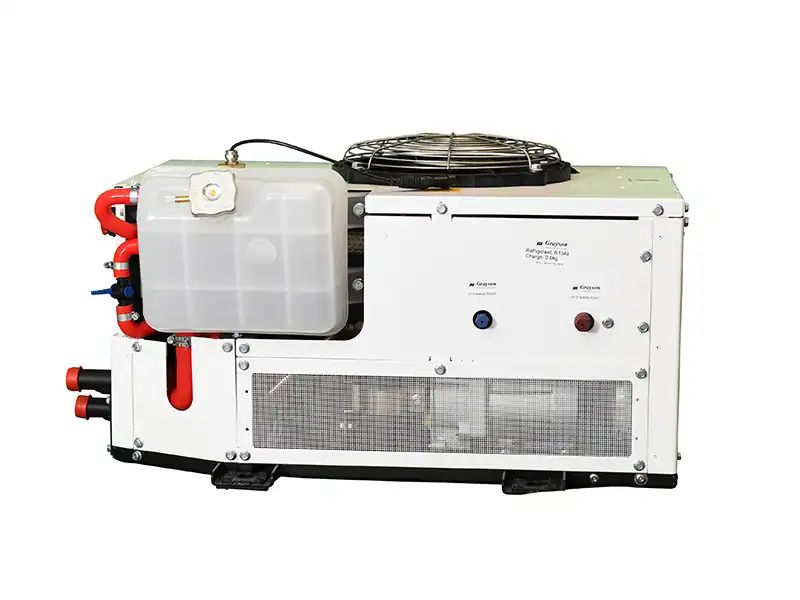
Explore Grayson’s product range to see the variety of thermal management solutions available for off-highway vehicles. Our range, including BTMS, Cooling and Auxiliary Heating, helps manufacturers address individual thermal requirements or bring multiple functions together within an integrated system. See some examples below or visit our off-highway product selection.
The role of heat in internal combustion engines
Internal combustion engines operate most efficiently at the correct temperature, usually between 85-105°C. In the colder conditions off-highway vehicles are often subject to, engines require extra fuel; while in warmer environments, overheated engines waste energy. Excess heat, or even the speed at which engine components heat up, can cause warping, cracking or seizing due to uneven expansion of pistons, cylinders and other metal parts. In off-highway vehicles especially, complex networks of wiring and electronics often surround the engine therefore, it is important to effectively manage and direct heat away from other critical components that may fail if overheated.
The role of heat in electrified systems
The efficient operating temperature windows of electrified or battery-powered systems are even more narrow (typically 15°C to 35°C). In contrast to internal combustion engines, battery systems generate heat as a byproduct of electrical resistance and chemical reactions. Excessive heat can reduce battery performance and lifespan and, in extreme circumstances, cause thermal runaway; a catastrophic chain reaction where the battery’s flammable and toxic gases are released and ignited, causing fires or explosions.
As the Off-highway sector explores new ways to reduce its environmental impact, the evolution of battery innovation is forcing heightened focus on thermal management. Batteries with higher energy densities, faster charging, emerging cell technology and more demanding duty cycles all increase the thermal load placed on the system, creating greater demands for effective battery thermal management.
Battery systems are also affected by colder temperatures, which can reduce power availability and cause problems with charging. If lithium-ion batteries are charged below freezing, the risks of permanent capacity loss and internal damage increase significantly.
The role of heat in hydraulic systems
Most forms of off-highway vehicles including agricultural machinery, excavators and loaders, rely heavily on hydraulic systems to perform their work. With propulsion systems and working equipment often reliant on hydraulics, not managing heat within these systems effectively can cause performance issues, component damage and costly failures.
Excessive temperatures can accelerate fluid degradation, resulting in changes in load-carrying capacities, as well as increasing friction between lubricated components to compromise their reliability. Excessive or insufficient temperatures can also damage rubber and plastic seals which maintain hydraulic pressure or protect the systems from dirt and debris. Damage here can cause contamination, pressure drops and leaks, all resulting in reduced system performance and potentially unplanned downtime.
The role of heat in maintaining operator comfort, concentration and safe operation
Extreme hot or cold temperatures within the operator’s cab can be a major cause of discomfort. As well as playing a role in overall working conditions and job satisfaction, getting cab temperature right has important health, safety and productivity benefits.
Excessive heat can contribute to dehydration and fatigue and, in the most extreme cases, heat exhaustion or heatstroke. When the body is fatigued, operators can take longer to process information and become prone to making mistakes. Another key risk factor here is that operators are more likely to try and adjust or remove important PPE to find relief, exposing themselves to potential hazards.
On the other hand, exposure to extremely low temperatures can reduce alertness, slow reaction times, and increase the risk of hypothermia or frostbite. Where off-highway machinery is concerned, natural bodily reactions such as finger numbness or shivering can impede the operator’s ability to safely control the vehicle and its systems, which often require precise or controlled movements.
Fluctuating temperatures and moisture in the cab vs the ambient operating temperature can also cause condensation build-up and, in turn, restrict visibility. Aside from the obvious safety hazards this presents, changes in temperatures can greatly reduce task accuracy and increase rework rates.
Thermal management: supporting off-highway productivity
Whether it’s an internal combustion engine, battery, hydraulic system or operator cab, managing heat effectively is essential to maintaining the performance of an off-highway vehicle. In an industry where prolonged operation, extreme environments and demanding workloads are the norm, even small losses in efficiency or reliability can quickly translate into costly downtime.
As off-highway vehicles continue to evolve, particularly as electrification gathers pace, thermal management is becoming an increasingly important consideration for manufacturers. From keeping batteries within their optimum operating range to maintaining comfortable conditions for operators, the right solution needs to account for the demands of the whole vehicle.
There is no one-size-fits-all approach, but getting thermal management right from the design stage can help off-highway vehicles operate more efficiently, reliably and safely, whatever the application.
Find out more about Grayson’s thermal management solutions for off-highway vehicles.


