






If you’ve worked on electrified platforms, you’ll already know this: thermal management has quietly become one of the most complex parts of the application.
It’s no longer just about keeping a battery within a safe temperature range, or ensuring the cabin stays comfortable. You’re now dealing with multiple thermal loads (hydrogen fuel cells, battery packs, power electronics, traction motor, cabin HVAC), all interacting with each other, often under demanding duty cycles and wide ambient conditions.
And the challenge isn’t just managing those loads; it’s managing them efficiently and simultaneously.
Traditionally, we’ve approached this by breaking the problem down. Separate systems, separate circuits, separate responsibilities. That approach made sense when architectures were simpler. But as electrification matures, it introduces its own challenges: duplication of components, inefficient use of energy, and ever-increasing integration complexity.
That’s where integrated thermal management starts to make more sense – not just as a product solution, but as a different way of thinking about the problem. So, what does that actually look like in practice? In this article, we’ll explore how an integrated system behaves under real operating conditions, and what opportunities it creates for engineers developing next-generation heavy vehicle platforms.
What do we mean by integrated thermal management?
When people talk about “integrated thermal management”, it can sound like a buzzword. In reality, it’s a fairly straightforward shift in mindset.
Instead of designing a battery cooling system, a powertrain cooling loop, and a cabin HVAC system as separate entities, you design a single thermal architecture that manages all of them together.
What that means in practice is that heat is no longer treated as something to simply remove and reject, instead becoming something you can move, reuse, and redistribute across the system.
For example, heat generated in the powertrain doesn’t have to be wasted. Under the right conditions, it can be used to support battery heating or cabin comfort. Likewise, cooling capacity can be shared dynamically, rather than fixed to individual subsystems.
And once you start looking at it that way, the limitations of traditional architectures become much clearer. So the next question is: what does an integrated system actually look like when it’s applied in a real vehicle?
In Summary:
- Thermal systems are designed as one coordinated architecture, not separate subsystems
- Heat is redistributed and reused, not just rejected
- Cooling and heating capacity is shared dynamically
- Control shifts from isolated loops to system-level management
What is the CM-series CTMS?
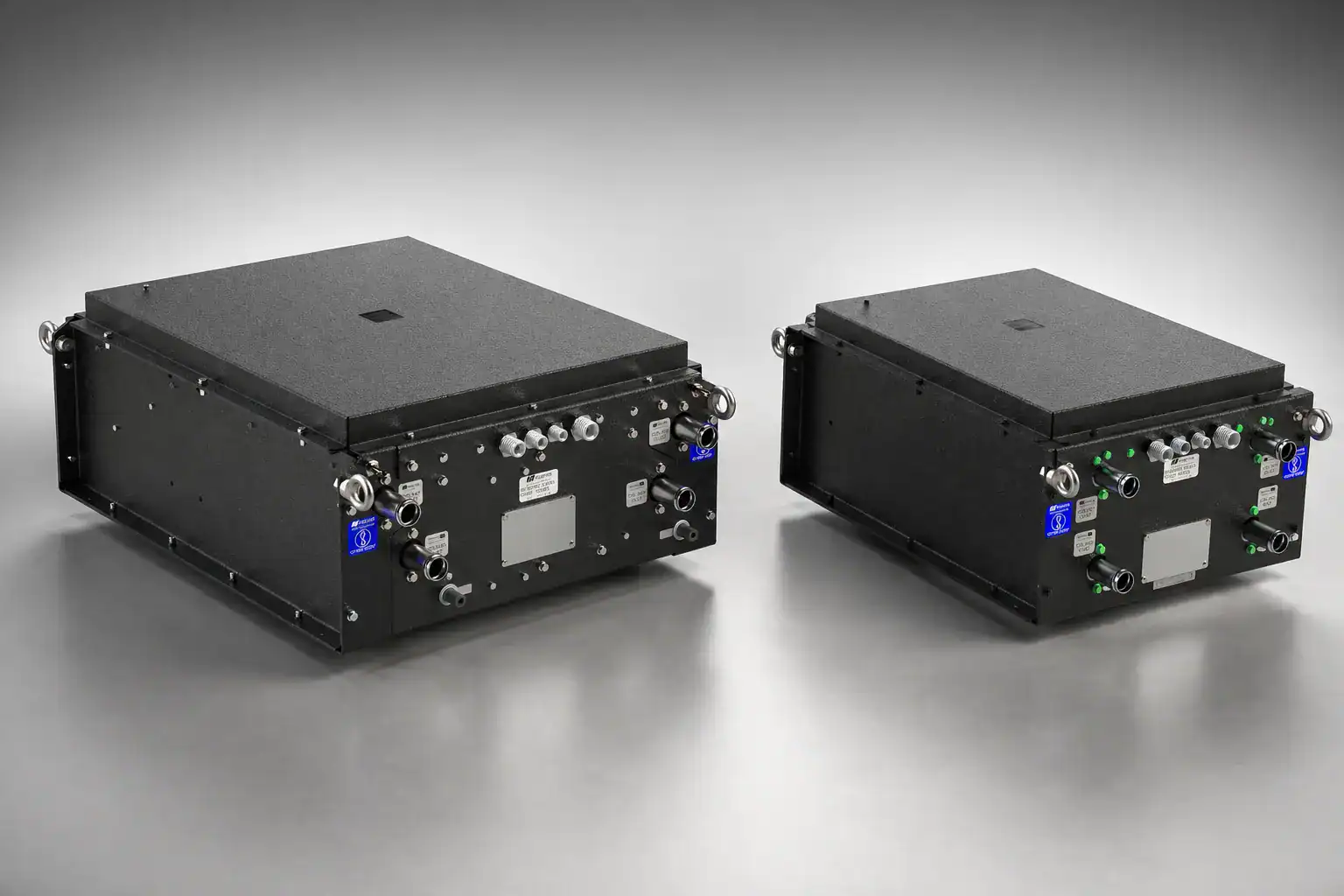
The CM-series Complete Thermal Management System (CTMS) is one way of implementing that integrated approach in a practical, deployable form.
At a high level, it’s a chassis-mounted thermal module that combines:
- Battery thermal management (heating, active cooling, passive cooling)
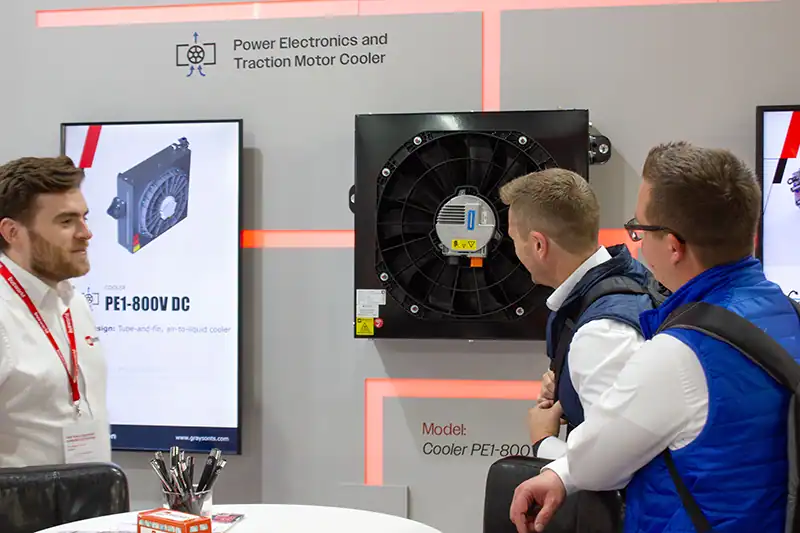
- Power electronics and traction motor cooling
- Cabin HVAC (heating, cooling, dehumidification)
…into a single system.
What’s important here isn’t just that these functions are present, but that they are designed to work together from the outset, rather than being brought together later during integration.
At the centre of the system is a reversible heat pump, supported by a refrigerant circuit and multiple coolant loops. This allows the system to switch between heating and cooling modes as required, while also enabling heat recovery between different parts of the vehicle.
Control is handled by an integrated Automatic Temperature Controller and Grayson proprietary software, which continuously adjusts how thermal energy is distributed across the system.
From an engineering perspective, it’s less about the individual components and more about how those components are orchestrated as part of a single system.
But understanding the architecture is one thing. The real value becomes clearer when you look at how the system behaves under different operating conditions because that’s where integrated thermal management starts to show its advantages.
In Summary:
- Single module integrating battery, powertrain, and HVAC thermal functions
- Built around a reversible heat pump and refrigerant circuit
- Uses multi-loop architecture to manage different thermal loads
- Intelligently controlled by integrated software for automatic temperature control
How does the system work?
The best way to understand an integrated system is to look at how it behaves under real operating conditions because that’s where the benefits become clear.
Low ambient conditions: passive cooling
In cooler environments, the system avoids using energy unnecessarily.
If ambient conditions allow, heat from the battery and powertrain is rejected directly through radiators. There’s no need to engage the compressor or run the refrigerant circuit.
It’s a simple principle, but an important one: don’t introduce complexity or energy draw unless the system actually needs it.

High thermal load conditions: active cooling and cabin air conditioning
As ambient temperatures rise, or as the vehicle begins operating under load, passive cooling alone is no longer sufficient.
At this point, the system transitions into active cooling:
- Heat is removed from the battery via a dedicated evaporator
- Cabin air is cooled through the HVAC evaporator
- Both heat loads are transferred into the powertrain coolant circuit
- The radiator then rejects the combined thermal load
What’s happening here is more than just cooling; it’s intelligent coordination.

Rather than separate systems independently rejecting heat, the CM-series brings those loads together and manages them through a shared pathway. The system can cool:
- The battery only
- The cabin only
- Or both simultaneously, depending on demand
From an HVAC perspective, this also means stable, consistent air conditioning performance, even when thermal loads elsewhere in the system are changing.
Unsure of the differences and use cases for active cooling vs passive cooling. Check out our informative article on the two cooling methods. Read our technical deep dive on direct vs indirect condensing.
Cold start and pre-conditioning
Cold conditions introduce a different challenge: the need to get the system up to an effective operating temperature.
In this mode:
- A PTC heater raises coolant temperature to enable efficient refrigerant system operation
- The heat pump then takes over, transferring heat where it’s needed
- The system can prioritise battery conditioning over cabin comfort
This prioritisation is software-controlled, meaning it can be adapted depending on the application and operating requirements. The key here is that thermal management isn’t reactive but strategic, ensuring temperature-sensitive batteries are within its optimal range before other systems are fully engaged.

Heating through heat recovery and air-sourced heat
Once the system is up and running, heating becomes far more efficient. There are two key mechanisms at play here:
First, heat recovery.
As the powertrain operates, it generates heat. Rather than rejecting that heat to ambient, the system can capture it and redirect it to:
- The battery
- The cabin
Second, air-sourced heating via the heat pump.
When ambient conditions allow, the system can extract heat directly from the air and use it to support heating demands. This significantly reduces reliance on electrical heating elements such as PTC heaters, which are typically more energy intensive.

In practice, the system will often combine both approaches, recovering heat where available, and supplementing it with air-sourced heat where needed. How efficiently that heat can be transferred between circuits depends on the condensing strategy used within the system, particularly in applications where indirect condensing is employed to manage multiple thermal loops.
Direct vs Indirect Condensing: Why It Matters
In integrated thermal systems, the way heat is transferred between refrigerant and coolant circuits has a direct impact on efficiency, control, and system flexibility. Understanding the difference between direct and indirect condensing is key to designing effective multi-loop thermal architectures. Read our technical deep dive on direct vs indirect condensing
This is where the integrated approach really begins to show its value: heat is no longer wasted but actively managed as a resource.
Cabin heating, cooling and dehumidification
Cabin HVAC isn’t just about temperature; it’s about control of the air itself.
In addition to heating and cooling, the CM-series also manages dehumidification, which is critical for:
- Windscreen demisting and de-icing
- Driver visibility
- Operator comfort in varying conditions
This is achieved by:
- Passing air through the evaporator to remove moisture
- Then reheating it via the condenser
The result is dry, conditioned air, rather than simply warm or cold air.
This is particularly important in off-highway and industrial applications, where environmental conditions can change rapidly and visibility is critical to safe operation.


Dynamic system behaviour in real operation
In reality, the system rarely operates in just one mode. You might have:
- Cabin heating while the battery requires cooling
- Passive battery cooling alongside active HVAC
- Heat recovery supporting both cabin and battery simultaneously
The system is constantly adapting, balancing loads, switching modes, and redistributing thermal energy in real time.
That’s where the control system becomes critical, as the CM-series is not just managing temperature; it’s managing interactions between multiple thermal demands.
At this point, the difference from a traditional setup starts to become much clearer. So it’s worth stepping back and asking: how does this compare to the way thermal systems are typically designed today?
In Summary:
- Passive cooling minimises energy use in low ambient conditions
- Active cooling enables simultaneous battery, cabin, and powertrain management
- Heat recovery reuses energy that would otherwise be lost
- Air-sourced heating reduces reliance on high-energy PTC systems
- Cabin HVAC includes air conditioning and dehumidification for visibility and comfort
- System behaviour is dynamic and software-driven, not fixed
How does this differ from a traditional approach?
If you compare this systems-level approach to a traditional thermal architecture, the difference becomes apparent.
In a conventional setup, each system is designed independently; each has its own components, controls, and interfaces; and heat is typically rejected rather than reused.
The result? More components, more packaging challenges, more integration effort, and more energy consumption.
An integrated system means fewer components performing multiple roles, shared thermal pathways centralised control, and more efficient use of available energy.
However, beyond just reducing parts, this new integrated approach improves how the system behaves, particularly under real-world operating conditions. And once you start thinking in those terms, it naturally leads to a different question: what does this change from an engineering perspective, and where are the real opportunities?
In Summary:
- Traditional systems are component-based and isolated
- Integrated systems are coordinated and multi-functional
- Heat is reused, not wasted
- Complexity shifts from hardware to system-level control
What opportunity does this create for OEM engineers?
To embrace this shift to ‘complete’ thermal management requires a change in both technical and strategic mindset by application designers. For engineers, it opens new ways of thinking about vehicle design.
Instead of designing around fixed subsystems, you can start to design around thermal energy flow, system-level efficiency, and integration and maintenance simplicity.
It also changes how trade-offs are managed. For example:
- You may reduce component count but increase control complexity
- You may gain efficiency but need to rethink packaging
- You may simplify integration but rely more on software
There’s also flexibility in how systems are implemented. The CM-series, for example, can be configured with:
- Fully integrated components in one single module – the CM1
- A fully distributed system for complete packaging flexibility – the CM3
- A hybrid with some elements (such as pumps and heaters) packaged externally – the CM2
This allows engineers to balance packaging constraints, serviceability and system architecture preferences. Ultimately, the opportunity is this to move away from solving individual thermal problems, and towards optimising the vehicle as a complete thermal system.
Where to Start?
For many engineers, the shift to integrated thermal management doesn’t begin with a completely new system but rather with a different way of looking at the problem.
Instead of asking how to optimise individual components, the starting point becomes understanding how thermal energy moves across the vehicle as a whole. Where is heat being generated? Where is it being rejected unnecessarily? And where could it be reused more effectively?
From there, it becomes possible to explore how systems can be combined, how control strategies can be aligned, and how thermal loads can be managed more intelligently across different operating conditions.
But, that’s not always a straightforward transition. It often involves rethinking established architectures, balancing new trade-offs, and working across disciplines – mechanical, electrical, and software – to achieve the right result.
This is where experience becomes important. We’ve spent almost 50 years developing thermal management solutions across battery systems, powertrain cooling and HVAC. That experience now comes together in integrated systems like the CM-series CTMS, combining these traditionally separate functions into a single, coordinated architecture designed for next-generation electrified applications.
Today, we’re already working with OEMs across off-highway, commercial vehicle, special vehicle and stationary power applications to help implement integrated thermal strategies in real-world applications, supporting everything from early-stage concept development through to production-ready systems.
If you’re exploring how integrated thermal management could apply to your platform, whether at a conceptual level or within an active project, it’s a conversation worth having. Our team of thermal engineers is always happy to share insight, discuss challenges, or simply explore what’s possible.
Related Articles


